Blog

  • Sweep Something Under the Rug


    Sweep Something Under the Rug Meaning

    🗓️ Idiom: Sweep Something Under the Rug (verb)


    💬 Meaning

    • To hide or ignore a problem instead of dealing with it.
    • To avoid responsibility by pretending an issue does not exist.

    🧠 Example Sentences

    • The company tried to sweep the scandal under the rug to protect its image.
    • Problems should be solved openly, not swept under the rug.
    • He accused the manager of sweeping safety issues under the rug.

    🏛️ Origin

    The idiom comes from the image of literally sweeping dirt under a rug to hide it from view. It became popular in the mid-20th century to describe avoiding problems instead of facing them directly, especially in politics and business.


    📝 Practice Exercises

    1. Fill in the blank:
    The board decided to ________ the issue under the rug instead of discussing it openly.

    Answer

    sweep

    2. Choose the correct meaning of “sweep something under the rug”:
    a) To clean up quickly
    b) To hide or ignore a problem
    c) To prepare for a meeting

    Answer

    b) To hide or ignore a problem

    3. Change the sentence using “sweep something under the rug”:
    “The manager ignored the complaints instead of fixing the problem.”

    Answer

    The manager swept the complaints under the rug instead of fixing the problem.


    ℹ️ Other Useful Pages


    📚 Learning Resources

    👉 Management and Leadership Idioms
    👉 Business English Idioms List

    👥 Support Spaces

    👉 Student Space
    👉 Tutor Toolkit

    ⭐️ Extras

    📫 Get a Daily Idiom
    🚀 Build a Business with AI


  • Pass the Buck


    Pass the Buck meaning

    🗓️ Idiom: Pass the buck (verb)


    💬 Meaning

    • To shift responsibility to someone else instead of taking it yourself.
    • To avoid blame or decision-making by making another person handle it.

    🧠 Example Sentences

    • The manager tried to pass the buck to his assistant when the report was late.
    • Good leaders take responsibility instead of passing the buck.
    • She accused her colleague of passing the buck during the meeting.

    🏛️ Origin

    The phrase comes from 19th-century poker games in the United States. A marker, often a knife with a buckhorn handle, was passed to show whose turn it was to deal. If a player did not want the responsibility, they could “pass the buck” to the next person. Over time, it came to mean avoiding responsibility.


    📝 Practice Exercises

    1. Fill in the blank:
    Instead of solving the problem, he tried to ________ the buck to someone else.

    Answer

    pass

    2. Choose the correct meaning of “pass the buck”:
    a) To give money to someone
    b) To avoid responsibility by giving it to someone else
    c) To promote teamwork

    Answer

    b) To avoid responsibility by giving it to someone else

    3. Change the sentence using “pass the buck”:
    “The director avoided responsibility and made the manager deal with the issue.”

    Answer

    The director passed the buck and made the manager deal with the issue.


    ℹ️ Other Useful Pages


    📚 Learning Resources

    👉 Management and Leadership Idioms
    👉 Business English Idioms List

    👥 Support Spaces

    👉 Student Space
    👉 Tutor Toolkit

    ⭐️ Extras

    📫 Get a Daily Idiom
    🚀 Build a Business with AI
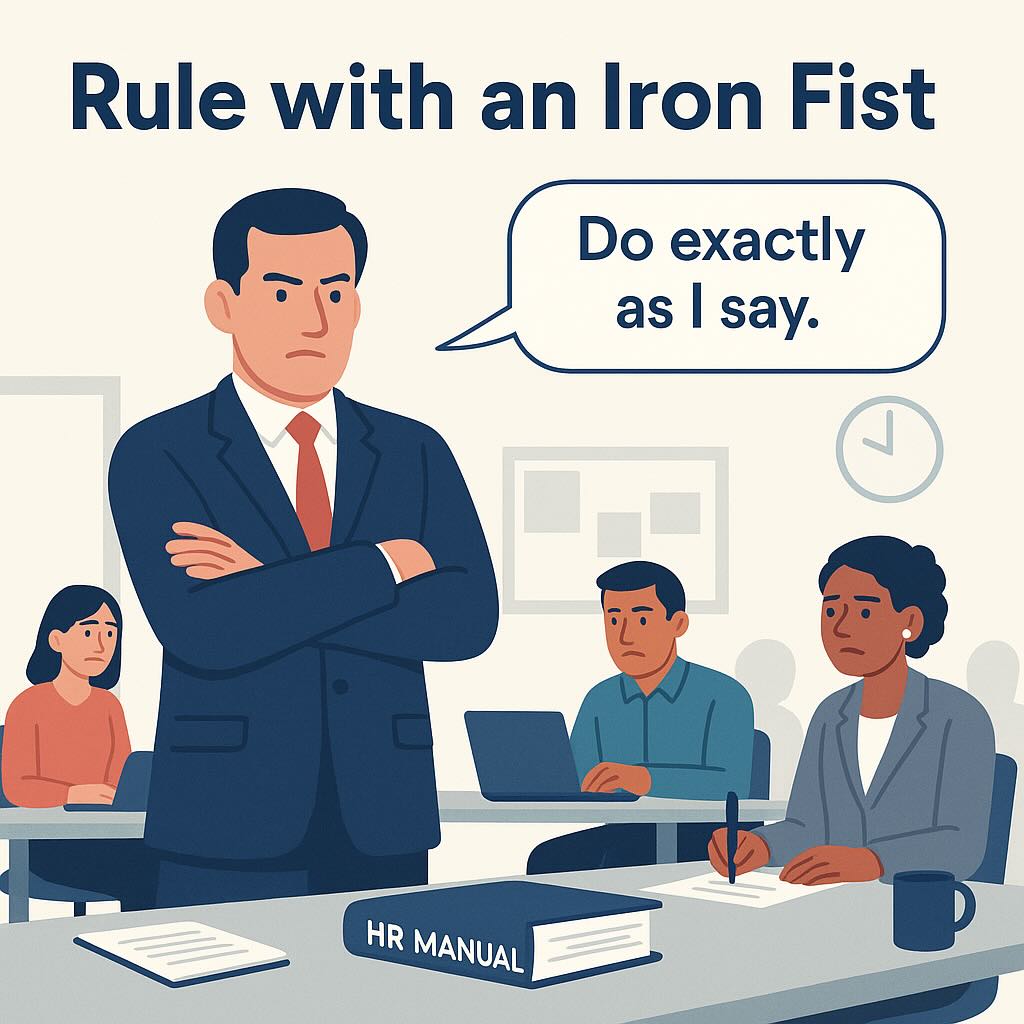

  • Rule With an Iron Fist


    Rule With an Iron Fist Meaning

    🗓️ Idiom: Rule With an Iron Fist (verb)


    💬 Meaning

    • To control people in a very strict or harsh way.
    • To lead with force, discipline, and little flexibility.

    🧠 Example Sentences

    • The CEO ruled with an iron fist, and employees were afraid to question decisions.
    • Some leaders rule with an iron fist to keep order, but it can lower morale.
    • He ruled his department with an iron fist, leaving no room for mistakes.

    🏛️ Origin

    The phrase “iron fist” has been used since the 1700s to describe strength, control, and lack of softness. It suggests leadership that is tough, firm, and unyielding, like iron. The idiom often has a negative meaning, describing strict or authoritarian control.


    📝 Practice Exercises

    1. Fill in the blank:
    The dictator continued to rule with an ________ fist for many years.

    Answer

    iron

    2. Choose the correct meaning of “rule with an iron fist”:
    a) To lead with kindness and care
    b) To lead with very strict or harsh control
    c) To avoid making decisions

    Answer

    b) To lead with very strict or harsh control

    3. Change the sentence using “rule with an iron fist”:
    “The manager controls the team with very strict and harsh rules.”

    Answer

    The manager rules the team with an iron fist.


    ℹ️ Other Useful Pages


    📚 Learning Resources

    👉 Management and Leadership Idioms
    👉 Business English Idioms List

    👥 Support Spaces

    👉 Student Space
    👉 Tutor Toolkit

    ⭐️ Extras

    📫 Get a Daily Idiom
    🚀 Build a Business with AI


  • Crack the Whip


    Crack the Whip Meaning

    🗓️ Idiom: Crack the Whip (verb)


    💬 Meaning

    • To use authority in a strict way to make people work harder.
    • To demand discipline or stronger effort from a team.

    🧠 Example Sentences

    • The manager had to crack the whip to get the project finished on time.
    • When deadlines are close, she cracks the whip to keep everyone focused.
    • The new team leader is known for cracking the whip during meetings.

    🏛️ Origin

    This idiom comes from the act of cracking a whip to drive horses or animals to move faster. In the 1800s, it started to be used in workplaces and politics to describe a leader pushing people to work harder or follow rules more strictly.


    📝 Practice Exercises

    1. Fill in the blank:
    The boss had to ________ the whip to make sure the team met the deadline.

    Answer

    crack

    2. Choose the correct meaning of “crack the whip”:
    a) To make people laugh
    b) To push people to work harder with strict control
    c) To encourage someone kindly

    Answer

    b) To push people to work harder with strict control

    3. Change the sentence using “crack the whip”:
    “The teacher became very strict before the final exams.”

    Answer

    The teacher cracked the whip before the final exams.


    ℹ️ Other Useful Pages


    📚 Learning Resources

    👉 Management and Leadership Idioms
    👉 Business English Idioms List

    👥 Support Spaces

    👉 Student Space
    👉 Tutor Toolkit

    ⭐️ Extras

    📫 Get a Daily Idiom
    🚀 Build a Business with AI


  • Hands Are Tied


    Hands Are Tied Meaning

    🗓️ Idiom: Hands are Tied (adjective)


    💬 Meaning

    • Unable to act or make changes because of rules, restrictions, or authority.
    • Powerless to take action even if you want to.

    🧠 Example Sentences

    • The manager said his hands were tied by the company’s strict policy.
    • She wanted to promote her team member, but her hands were tied by the budget limits.
    • Our hands are tied until the board gives final approval.

    🏛️ Origin

    The expression “hands are tied” comes from the literal image of a person’s hands being bound so they cannot move or act. It has been used since the 1600s in English to describe situations where someone is restricted or powerless, especially in legal or organizational contexts.


    📝 Practice Exercises

    1. Fill in the blank:
    I would like to give you more time off, but my ________ are tied by company policy.

    Answer

    hands

    2. Choose the correct meaning of “hands are tied”:
    a) Someone is physically restrained
    b) Someone cannot act because of rules or limits
    c) Someone is too busy to help

    Answer

    b) Someone cannot act because of rules or limits

    3. Change the sentence using “hands are tied”:
    “The director cannot approve the project because the law does not allow it.”

    Answer

    The director cannot approve the project because his hands are tied.


    ℹ️ Other Useful Pages


    📚 Learning Resources

    👉 Management and Leadership Idioms
    👉 Business English Idioms List

    👥 Support Spaces

    👉 Student Space
    👉 Tutor Toolkit

    ⭐️ Extras

    📫 Get a Daily Idiom
    🚀 Build a Business with AI


  • Let Someone Go


    Let someone go meaning

    🗓️ Idiom: Let someone go (verb)


    💬 Meaning

    • To politely say that someone is fired from their job.
    • To end someone’s employment without using harsh words.

    🧠 Example Sentences

    • The company had to let several employees go during the budget cuts.
    • After the project ended, management decided to let the temporary staff go.
    • HR explained that they were letting him go because his role was no longer needed.

    🏛️ Origin

    The phrase “let someone go” became common in the 20th century as a softer way to say “fire” or “dismiss.” Businesses started using it to reduce the emotional impact of job loss, especially in formal meetings or HR situations.


    📝 Practice Exercises

    1. Fill in the blank:
    Due to the company merger, they had to _______ several employees _____.

    Answer

    let several employees go

    2. Choose the correct meaning of “let someone go”:
    a) Allow an employee to leave early from work
    b) Fire someone in a polite way
    c) Encourage someone to take a vacation

    Answer

    b) Fire someone in a polite way

    3. Change the sentence using “let someone go”:
    “The manager decided to fire two team members last week.”

    Answer

    The manager decided to let two team members go last week.


    ℹ️ Other Useful Pages


    📚 Learning Resources

    👉 Management & Leadership Idioms
    👉 Business English Idioms List

    👥 Support Spaces

    👉 Student Space
    👉 Tutor Toolkit

    ⭐️ Extras

    📫 Get a Daily Idiom
    🚀 Build a Business with AI

    ⭐️ Extras

    📫 Get a Daily Idiom
    🚀 Build a Business with AI


  • Show Someone the Door


    Show someone the door meaning

    🗓️ Idiom: Show Someone the Door (verb)


    💬 Meaning

    • To dismiss someone or ask them to leave.
    • To remove someone from a job, meeting, or place.

    🧠 Example Sentences

    • After the argument, the manager showed him the door.
    • The company showed the consultant the door when his contract ended.
    • She was shown the door after repeatedly missing deadlines.

    🏛️ Origin

    This idiom comes from the simple act of guiding someone to the door when they are no longer welcome. Over time, it became a metaphor for dismissing or firing someone.


    📝 Practice Exercises

    1. Fill in the blank:
    After he insulted the client, the boss __________ immediately.

    Answer

    showed him the door

    2. Multiple choice:
    What does show someone the door mean?
    a) To guide someone politely to another room
    b) To ask someone to leave or dismiss them
    c) To promote someone to a higher role

    Answer

    b) To ask someone to leave or dismiss them

    3. Change the sentence using “show someone the door”:
    The manager asked the employee to leave after the meeting.

    Answer

    The manager showed the employee the door after the meeting.


    ℹ️ Other Useful Pages


    📚 Learning Resources

    👉 Management & Leadership Idioms
    👉 Business English Idioms List

    👥 Support Spaces

    👉 Student Space
    👉 Tutor Toolkit

    ⭐️ Extras

    📫 Get a Daily Idiom
    🚀 Build a Business with AI
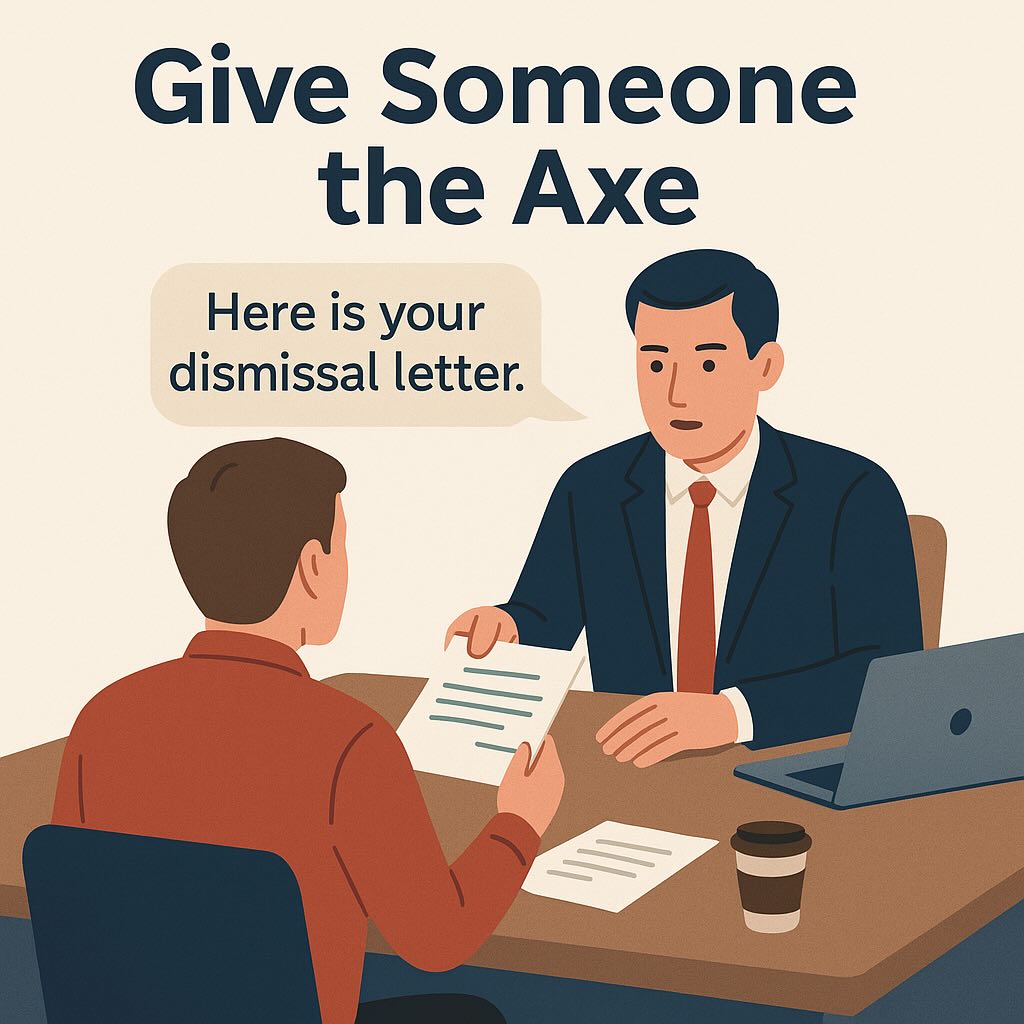

  • Give Someone the Axe


    Give Someone the Axe meaning

    🗓️ Idiom: Give Someone the Axe (verb)


    💬 Meaning

    • To dismiss someone from their job.
    • To fire or remove someone from a position.

    🧠 Example Sentences

    • After months of poor performance, the company gave him the axe.
    • The department was over budget, so three employees were given the axe.
    • The manager was worried about being given the axe during the restructuring.

    🏛️ Origin

    This idiom comes from the image of cutting with an axe. In the past, it was used as a strong metaphor for ending someone’s employment, just like chopping something off.


    📝 Practice Exercises

    1. Fill in the blank:
    When the project failed, the director was __________ by the board.

    Answer

    given the axe

    2. Multiple choice:
    What does give someone the axe mean?
    a) To cut wood with an axe
    b) To promote someone at work
    c) To dismiss someone from their job

    Answer

    c) To dismiss someone from their job

    3. Change the sentence using “give someone the axe”:
    The company decided to fire several employees last week.

    Answer

    The company gave several employees the axe last week.


    ℹ️ Other Useful Pages


    📚 Learning Resources

    👉 Management & Leadership Idioms
    👉 Business English Idioms List

    👥 Support Spaces

    👉 Student Space
    👉 Tutor Toolkit

    ⭐️ Extras

    📫 Get a Daily Idiom
    🚀 Build a Business with AI
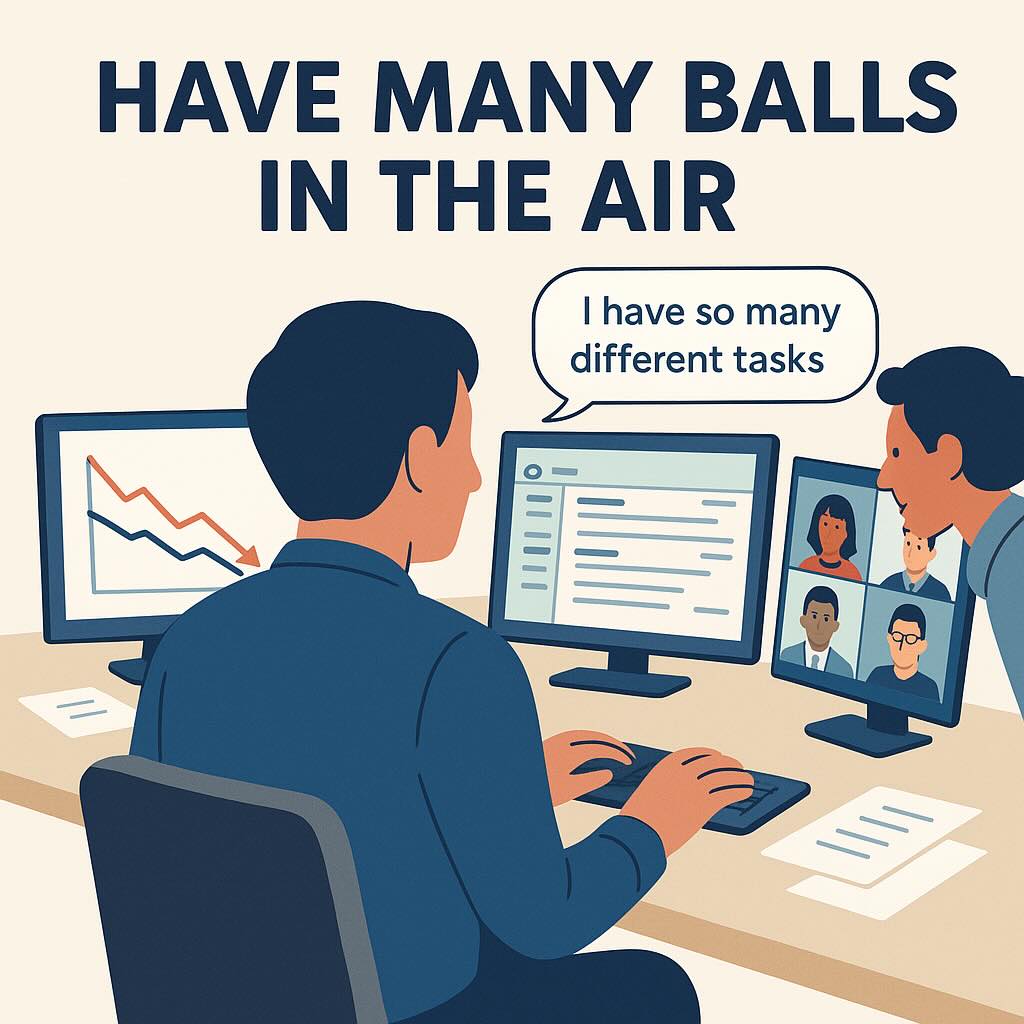

  • Have Many Balls in the Air


    Have many Balls in the Air meaning

    🗓️ Idiom: Have Many Balls in the Air (verb)


    💬 Meaning

    • To manage many tasks or responsibilities at the same time.
    • To juggle several projects or activities at once.

    🧠 Example Sentences

    • As a manager, she always has many balls in the air, from budgets to staff training.
    • He had many balls in the air during the product launch.
    • Our department has many balls in the air as we prepare for the annual report.

    🏛️ Origin

    This idiom comes from juggling. A juggler keeps several balls in the air without dropping them, just like someone handling many tasks at the same time.


    📝 Practice Exercises

    1. Fill in the blank:
    During the busy season, the HR manager had __________ with hiring, training, and payroll all happening at once.

    Answer

    many balls in the air

    2. Multiple choice:
    What does have many balls in the air mean?
    a) To play a sport
    b) To manage many tasks at the same time
    c) To drop responsibilities

    Answer

    b) To manage many tasks at the same time

    3. Change the sentence using “have many balls in the air”:
    She is handling several important projects at once.

    Answer

    She has many balls in the air.


    ℹ️ Other Useful Pages


    📚 Learning Resources

    👉 Management & Leadership Idioms
    👉 Business English Idioms List

    👥 Support Spaces

    👉 Student Space
    👉 Tutor Toolkit

    ⭐️ Extras

    📫 Get a Daily Idiom
    🚀 Build a Business with AI
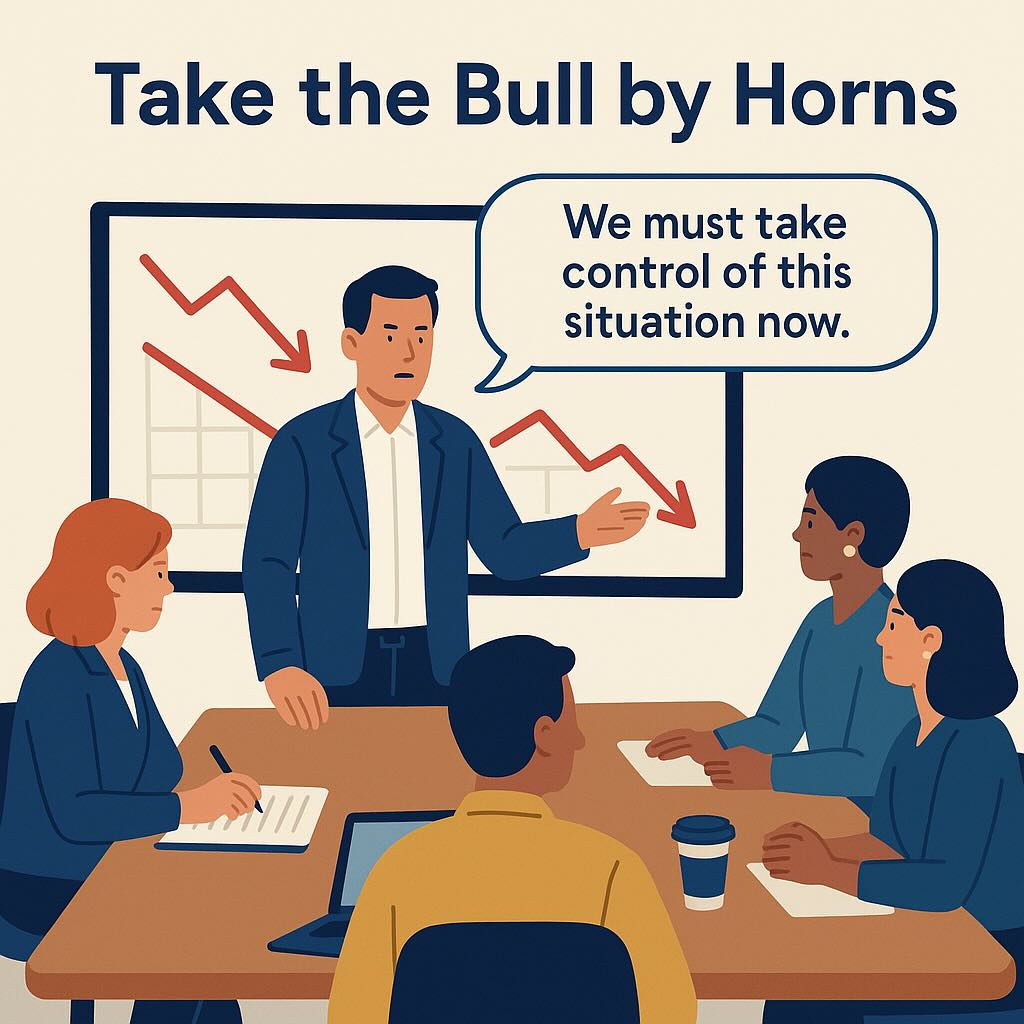

  • Take the Bull by the Horns


    Take the Bull by the Horns Meaning

    🗓️ Idiom: Take the Bull by the Horns (verb)


    💬 Meaning

    • To deal with a difficult situation directly and confidently.
    • To take control and act decisively.

    🧠 Example Sentences

    • The project was behind schedule, so she took the bull by the horns and reorganized the team.
    • He took the bull by the horns and addressed the conflict head-on.
    • To save the company, the CEO took the bull by the horns and made some tough decisions.

    🏛️ Origin

    This idiom comes from bullfighting. Taking the bull by the horns is extremely brave and dangerous, so it became a metaphor for tackling a difficult problem directly.


    📝 Practice Exercises

    1. Fill in the blank:
    The manager decided to __________ and handle the complaints personally.

    Answer

    take the bull by the horns

    2. Multiple choice:
    What does “take the bull by the horns” mean?
    a) To fight an animal
    b) To face a problem directly and decisively
    c) To avoid a difficult situation

    Answer

    b) To face a problem directly and decisively

    3. Change the sentence using “take the bull by the horns”:
    She went straight to the problem area and solved a major issue.

    Answer

    She took the bull by the horns and solved a major issue.


    ℹ️ Other Useful Pages


    📚 Learning Resources

    👉 Management & Leadership Idioms
    👉 Business English Idioms List

    👥 Support Spaces

    👉 Student Space
    👉 Tutor Toolkit

    ⭐️ Extras

    📫 Get a Daily Idiom
    🚀 Build a Business with AI