Tag: Negations

  • Bring Something to the Table


    🗓️ Idiom: Bring Something to the Table (verb)


    💬 Meaning

    • To contribute a skill, idea, or resource to a discussion or project.
    • To offer something useful or valuable in a team or negotiation.

    🧠 Example Sentences

    • Every team member should bring something to the table during strategy meetings.
    • She brings years of experience to the table that will help the project succeed.
    • The new partner brought valuable contacts to the table.

    🏛️ Origin

    This idiom comes from the idea of placing something on a table where people are discussing or negotiating. It has been used in business and negotiation contexts since the mid-20th century to describe contributing something useful to a group or discussion.


    📝 Practice Exercises

    1. Fill in the blank:
    In negotiations, it is important to __________ something to the table.

    Answer

    bring

    2. Multiple choice:
    What does “bring something to the table” mean?
    a) To contribute something valuable
    b) To arrive at a meeting
    c) To take items away from a discussion

    Answer

    a) To contribute something valuable

    3. Change the sentence using bring something to the table:
    She offered her expertise to help with the project.

    Answer

    She brought her expertise to the table to help with the project.


    ℹ️ Other Useful Pages


    📚 Learning Resources

    👉 Negotiation Idioms
    👉 Business English Idioms List

    👥 Support Spaces

    👉 Student Space
    👉 Tutor Toolkit

    ⭐️ Extras

    📫 Get a Daily Idiom
    🚀 Build a Business with AI


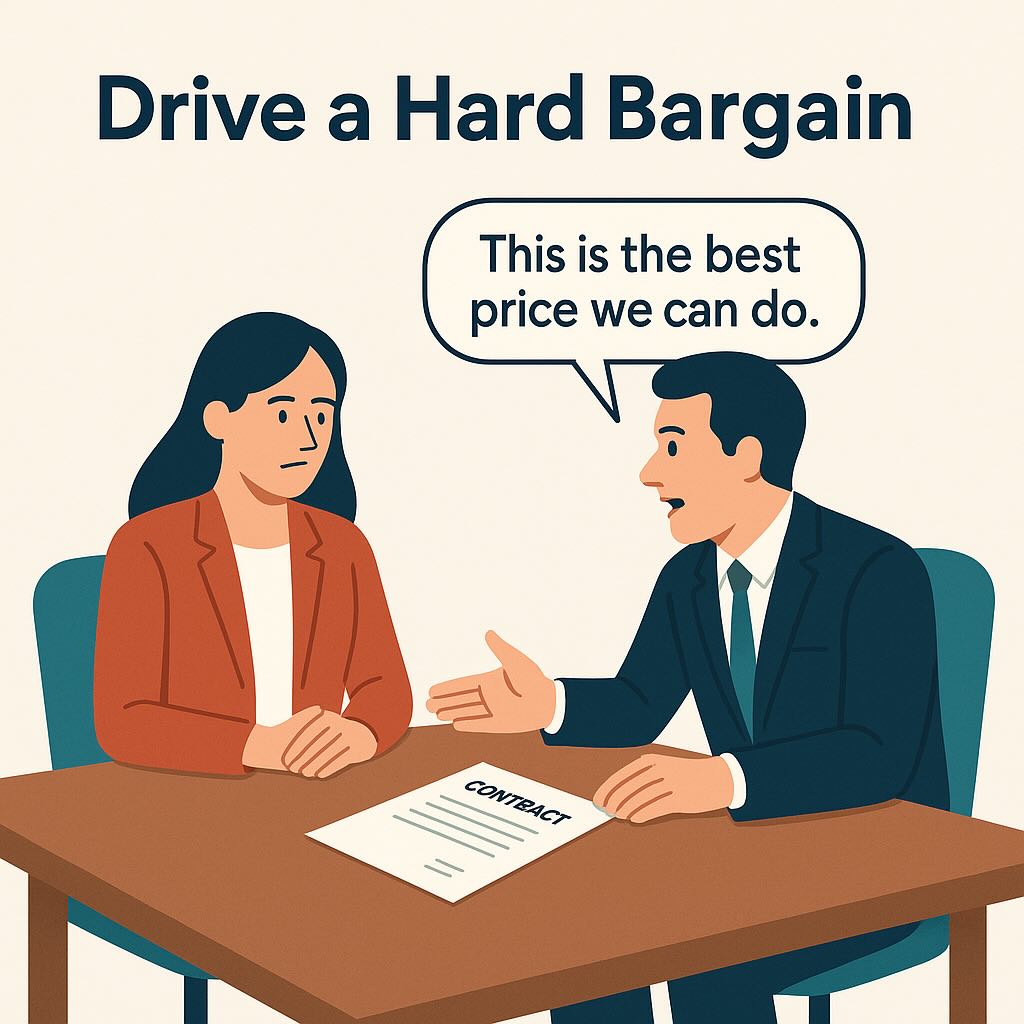
  • Drive a Hard Bargain


    Business English idiom “Drive a Hard Bargain” illustrated with a professional firmly negotiating terms while staying calm and confident.

    🗓️ Idiom: Drive a Hard Bargain (v)


    💬 Meaning

    • To negotiate strictly so that you get favorable terms.
    • To make demands or conditions that are tough but fair.

    🧠 Example Sentences

    • She knows how to drive a hard bargain in contract talks.
    • Suppliers who drive a hard bargain often get better prices.
    • He drove a hard bargain but still maintained a good relationship with the client.

    🏛️ Origin

    This idiom comes from trade and commerce. To “drive a bargain” originally meant to push hard during bargaining. Over time, “drive a hard bargain” emphasized being tough and firm in negotiations. It has been used in English since the 1800s.


    📝 Practice Exercises

    1. Fill in the blank:
    During the meeting, our side __________ a hard bargain to achieve lower costs.

    Answer

    drove

    2. Multiple choice:
    What does “drive a hard bargain” mean?
    a) To offer very little in a deal
    b) To negotiate with firmness and get favorable terms
    c) To refuse to negotiate at all

    Answer

    b) To negotiate with firmness and get favorable terms

    3. Change the sentence using drive a hard bargain:
    The buyer insisted on very strict terms during the negotiation.

    Answer

    The buyer drove a hard bargain.


    ℹ️ Other Useful Pages


    📚 Learning Resources

    👉 Negotiation Idioms
    👉 Business English Idioms List

    👥 Support Spaces

    👉 Student Space
    👉 Tutor Toolkit

    ⭐️ Extras

    📫 Get a Daily Idiom
    🚀 Build a Business with AI


  • Business Negotiation Idioms and Phrases


    🤝 20 Business Negotiation Idioms and Phrases


    Hey there! 👋

    Have you ever been in a negotiation and heard phrases like “meet me halfway” or “sweeten the deal”, and thought, “What do these really mean?”

    You’re definitely not alone. 😁

    That’s exactly why I’ve created this Business Negotiation Idioms and Phrases hub page.

    It brings together the expressions my students ask about most.

    This Business Negotiation Idioms and Phrases page shows you 20 common expressions used in:

    • Negotiations with suppliers
    • Discussions with partners
    • Conversations with clients
    • Contracts and agreements

    Once you understand them, conversations become easier to follow.

    You’ll also start sounding more confident and more persuasive in negotiations.

    Each idiom on this page includes:

    • a simple explanation
    • a real workplace example
    • a quiz question to help you practise
    • a link to a full idiom page

    You can use this page to:

    • go through the idioms at your own pace
    • say them out loud to build confidence
    • come back to this page anytime as a reference

    Enjoy the lesson and see you in the next one!

    Teacher Rob 🙋‍♂️


    💪 Tough Negotiation Tactics


    1. 👉 Drive a Hard Bargain (v)

    Meaning: Negotiate strongly to get the best deal.
    Example: She drove a hard bargain to get a lower price.


    2. 👉 Play Hard Ball (v)

    Meaning: Negotiate in a very tough way.
    Example: The company played hard ball to protect its interests.


    3. 👉 Stand Your Ground (v)

    Meaning: Refuse to change your position.
    Example: She stood her ground during the contract talks.


    4. 👉 Dig Your Heels In (v)

    Meaning: Strongly refuse to change your opinion.
    Example: He dug his heels in and would not accept the offer.


    5. 👉 Play Your Cards Right (v)

    Meaning: Act smartly to get a good result.
    Example: If we play our cards right, we can win the deal.


    ✅ Quick Quiz


    1. If someone “drives a hard bargain”, they:


    2. When a company “plays hard ball”, it:


    3. If you “stand your ground” in a negotiation, you:


    4. Someone who “digs their heels in” will:


    5. If you “play your cards right”, you:


    🧑‍💻 Strategy


    6. 👉 Keep Your Cards Close to Your Chest (v)

    Meaning: Keep plans or information secret.
    Example: She kept her cards close to her chest during talks.


    7. 👉 Have an Ace Up Your Sleeve (v)

    Meaning: Have a hidden advantage.
    Example: He had an ace up his sleeve for the final meeting.


    8. 👉 Read Between the Lines (v)

    Meaning: Understand hidden meaning.
    Example: She read between the lines and saw the real issue.


    9. 👉 Bring (something) to the Table (v)

    Meaning: Offer skills or value.
    Example: He brought strong experience to the table.


    10. 👉 Leave No Stone Unturned (v)

    Meaning: Try every possible option.
    Example: We left no stone unturned to find a good partner.


    ✅ Quick Quiz


    1. If someone “keeps their cards close to their chest”, they:


    2. Having “an ace up your sleeve” means you:


    3. If you “read between the lines”, you:


    4. When someone “brings something to the table”, they:


    5. If a team “leaves no stone unturned”, they:


    🗣️ Persuasion and Discussion


    11. 👉 Talk Someone Into Something (v)

    Meaning: Persuade someone to agree.
    Example: She talked the client into signing the contract.


    12. 👉 Talk Someone Out of Something (v)

    Meaning: Persuade someone not to do something.
    Example: He talked her out of making a risky deal.


    13. 👉 Talk Something Over (v)

    Meaning: Discuss carefully before deciding.
    Example: Let’s talk the proposal over first.


    14. 👉 See Both Sides of the Coin (v)

    Meaning: Understand different views.
    Example: Good negotiators see both sides of the coin.


    15. 👉 Sleep on It (v)

    Meaning: Decide later after thinking.
    Example: I’ll sleep on it and reply tomorrow.


    🤝 Agreement and Outcomes


    16. 👉 Change Your Mind (v)

    Meaning: Decide differently.
    Example: She changed her mind after reviewing the details.


    17. 👉 Win-Win Situation (n)

    Meaning: A result that benefits everyone.
    Example: The agreement was a win-win situation.


    18. 👉 Find Common Ground (v)

    Meaning: Discover shared interests.
    Example: Both sides found common ground quickly.


    19. 👉 Strike a Deal (v)

    Meaning: Reach an agreement.
    Example: They struck a deal after long talks.


    20. 👉 No Strings Attached (adj)

    Meaning: With no conditions.
    Example: The offer came with no strings attached.


    ✅ Quick Quiz


    1. If you “change your mind”, you:


    2. A “win-win situation” is one where:


    3. When two sides “find common ground”, they:


    4. If people “strike a deal”, they:


    5. An offer with “no strings attached”:


    Did you get 100%?


    Conclusion

    There you go –

    A great set of business negotiation idioms and phrases you can start using right away!

    I promise you’ll spot these in your next:

    • deal talk
    • client meeting
    • contract discussion

    And now you’ll know exactly what they mean (and how to drop them in yourself).

    Which one surprised you the most?

    My favourite is “play hardball”.

    It really captures those tough moments!

    Let me know your favourite in the comments below.

    I always love hearing from you.

    Ready for more?

    Check out our other idiom guides for:

    👉  Visit my A-Z idiom category page to see more.

    Happy learning,

    Teacher Rob 🙋‍♂️


    Need help learning the idioms?

    Check out my 👉 Best Way to Learn Idioms Quickly Page


    ℹ️ Other Useful Pages


    📚 Learning Resources

    👉 Business English Idioms List

    👥 Support Spaces

    👉 Student Space
    👉 Tutor Toolkit

    ⭐️ Extras

    📫 Get a Daily Idiom


    I hope you enjoyed my Business Negotiation Idioms and Phrases.