Tag: management and leadership

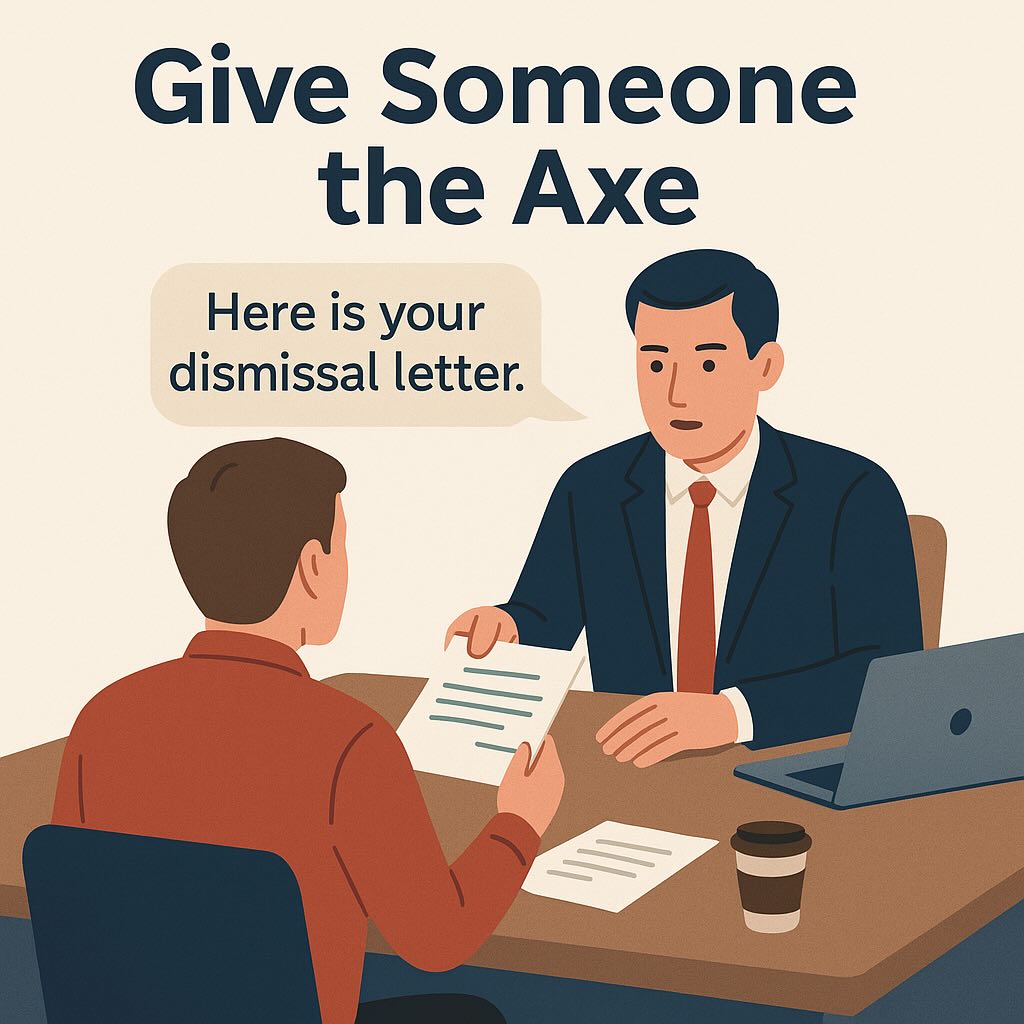
  • Give Someone the Axe


    Give Someone the Axe meaning

    🗓️ Idiom: Give Someone the Axe (verb)


    💬 Meaning

    • To dismiss someone from their job.
    • To fire or remove someone from a position.

    🧠 Example Sentences

    • After months of poor performance, the company gave him the axe.
    • The department was over budget, so three employees were given the axe.
    • The manager was worried about being given the axe during the restructuring.

    🏛️ Origin

    This idiom comes from the image of cutting with an axe. In the past, it was used as a strong metaphor for ending someone’s employment, just like chopping something off.


    📝 Practice Exercises

    1. Fill in the blank:
    When the project failed, the director was __________ by the board.

    Answer

    given the axe

    2. Multiple choice:
    What does give someone the axe mean?
    a) To cut wood with an axe
    b) To promote someone at work
    c) To dismiss someone from their job

    Answer

    c) To dismiss someone from their job

    3. Change the sentence using “give someone the axe”:
    The company decided to fire several employees last week.

    Answer

    The company gave several employees the axe last week.


    ℹ️ Other Useful Pages


    📚 Learning Resources

    👉 Management & Leadership Idioms
    👉 Business English Idioms List

    👥 Support Spaces

    👉 Student Space
    👉 Tutor Toolkit

    ⭐️ Extras

    📫 Get a Daily Idiom
    🚀 Build a Business with AI


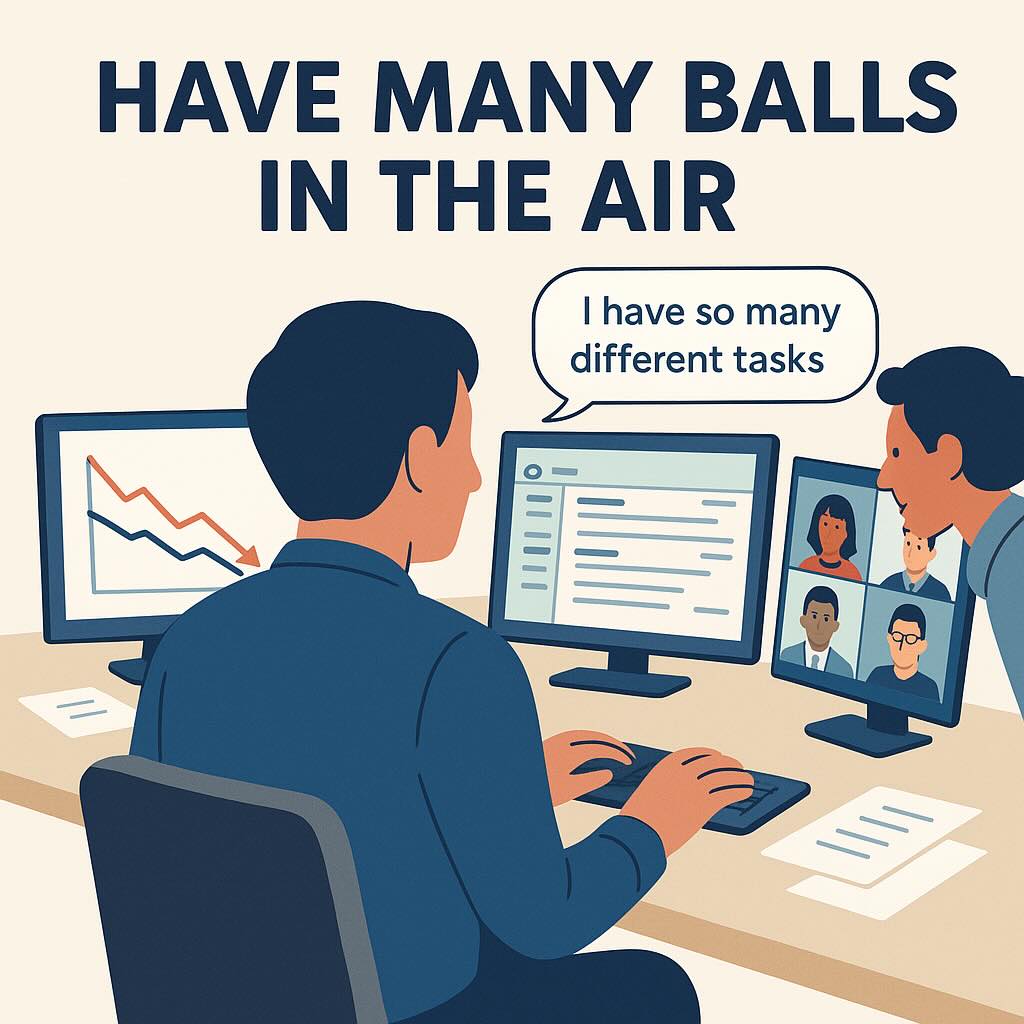
  • Have Many Balls in the Air


    Have many Balls in the Air meaning

    🗓️ Idiom: Have Many Balls in the Air (verb)


    💬 Meaning

    • To manage many tasks or responsibilities at the same time.
    • To juggle several projects or activities at once.

    🧠 Example Sentences

    • As a manager, she always has many balls in the air, from budgets to staff training.
    • He had many balls in the air during the product launch.
    • Our department has many balls in the air as we prepare for the annual report.

    🏛️ Origin

    This idiom comes from juggling. A juggler keeps several balls in the air without dropping them, just like someone handling many tasks at the same time.


    📝 Practice Exercises

    1. Fill in the blank:
    During the busy season, the HR manager had __________ with hiring, training, and payroll all happening at once.

    Answer

    many balls in the air

    2. Multiple choice:
    What does have many balls in the air mean?
    a) To play a sport
    b) To manage many tasks at the same time
    c) To drop responsibilities

    Answer

    b) To manage many tasks at the same time

    3. Change the sentence using “have many balls in the air”:
    She is handling several important projects at once.

    Answer

    She has many balls in the air.


    ℹ️ Other Useful Pages


    📚 Learning Resources

    👉 Management & Leadership Idioms
    👉 Business English Idioms List

    👥 Support Spaces

    👉 Student Space
    👉 Tutor Toolkit

    ⭐️ Extras

    📫 Get a Daily Idiom
    🚀 Build a Business with AI


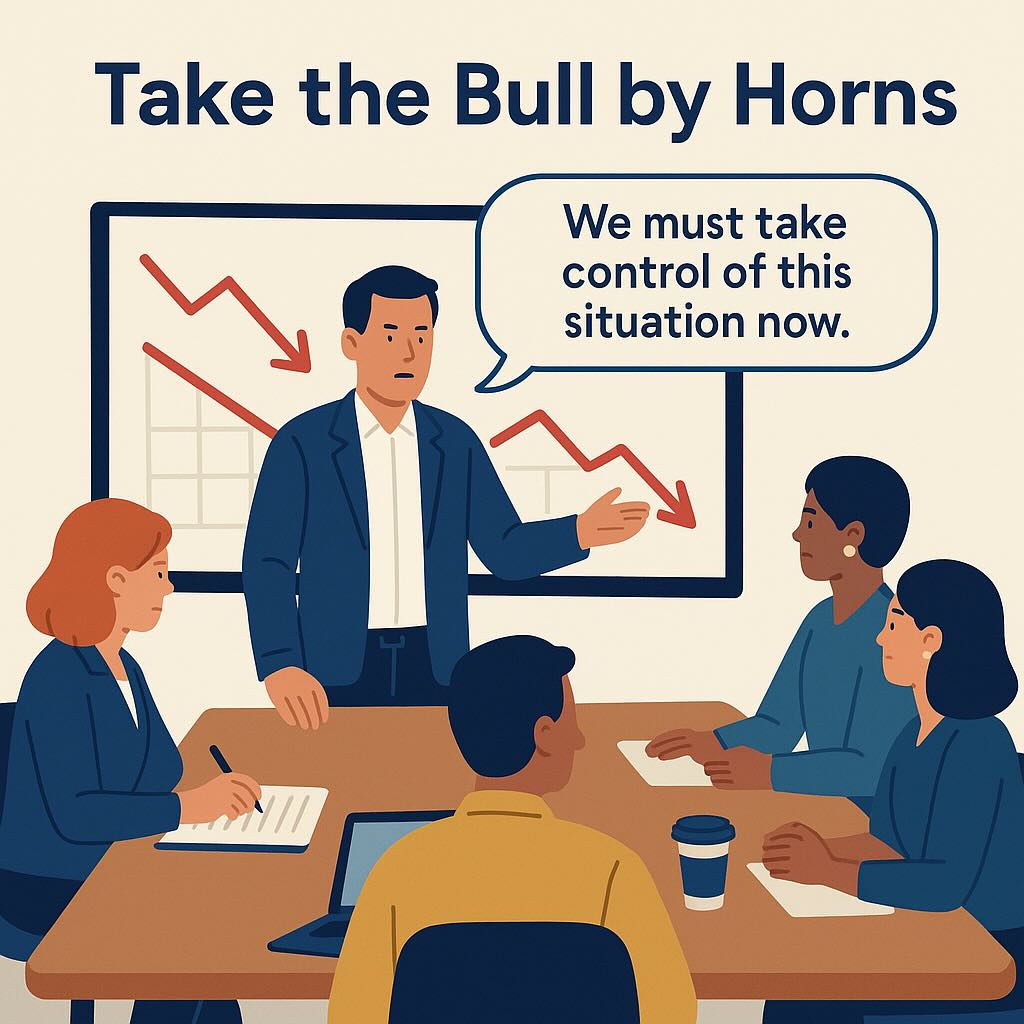
  • Take the Bull by the Horns


    Take the Bull by the Horns Meaning

    🗓️ Idiom: Take the Bull by the Horns (verb)


    💬 Meaning

    • To deal with a difficult situation directly and confidently.
    • To take control and act decisively.

    🧠 Example Sentences

    • The project was behind schedule, so she took the bull by the horns and reorganized the team.
    • He took the bull by the horns and addressed the conflict head-on.
    • To save the company, the CEO took the bull by the horns and made some tough decisions.

    🏛️ Origin

    This idiom comes from bullfighting. Taking the bull by the horns is extremely brave and dangerous, so it became a metaphor for tackling a difficult problem directly.


    📝 Practice Exercises

    1. Fill in the blank:
    The manager decided to __________ and handle the complaints personally.

    Answer

    take the bull by the horns

    2. Multiple choice:
    What does “take the bull by the horns” mean?
    a) To fight an animal
    b) To face a problem directly and decisively
    c) To avoid a difficult situation

    Answer

    b) To face a problem directly and decisively

    3. Change the sentence using “take the bull by the horns”:
    She went straight to the problem area and solved a major issue.

    Answer

    She took the bull by the horns and solved a major issue.


    ℹ️ Other Useful Pages


    📚 Learning Resources

    👉 Management & Leadership Idioms
    👉 Business English Idioms List

    👥 Support Spaces

    👉 Student Space
    👉 Tutor Toolkit

    ⭐️ Extras

    📫 Get a Daily Idiom
    🚀 Build a Business with AI


  • In the Driver’s Seat


    in the driver's seat meaning

    🗓️ Idiom: In the Driver’s Seat (idiom)


    💬 Meaning

    • To be in control of a situation.
    • To have the power to make decisions.

    🧠 Example Sentences

    • After the merger, the new CEO was in the driver’s seat.
    • The investor is in the driver’s seat when deciding which projects get funding.
    • With our strong sales numbers, we are in the driver’s seat for negotiating better contracts.

    🏛️ Origin

    This idiom comes from the image of a driver controlling a car. The person in the driver’s seat chooses where to go, just like a leader controls the direction of a project or company.


    📝 Practice Exercises

    1. Fill in the blank:
    After the successful product launch, the company was __________ when talking to suppliers.

    Answer

    in the driver’s seat

    2. Multiple choice:
    What does in the driver’s seat mean?
    a) To travel in a car
    b) To be in control of a situation
    c) To give advice to a leader

    Answer

    b) To be in control of a situation

    3. Change the sentence using “in the driver’s seat”:
    The manager has full control of the project.

    Answer

    The manager is in the driver’s seat for the project.


    ℹ️ Other Useful Pages


    📚 Learning Resources

    👉 Management & Leadership Idioms
    👉 Business English Idioms List

    👥 Support Spaces

    👉 Student Space
    👉 Tutor Toolkit

    ⭐️ Extras

    📫 Get a Daily Idiom
    🚀 Build a Business with AI


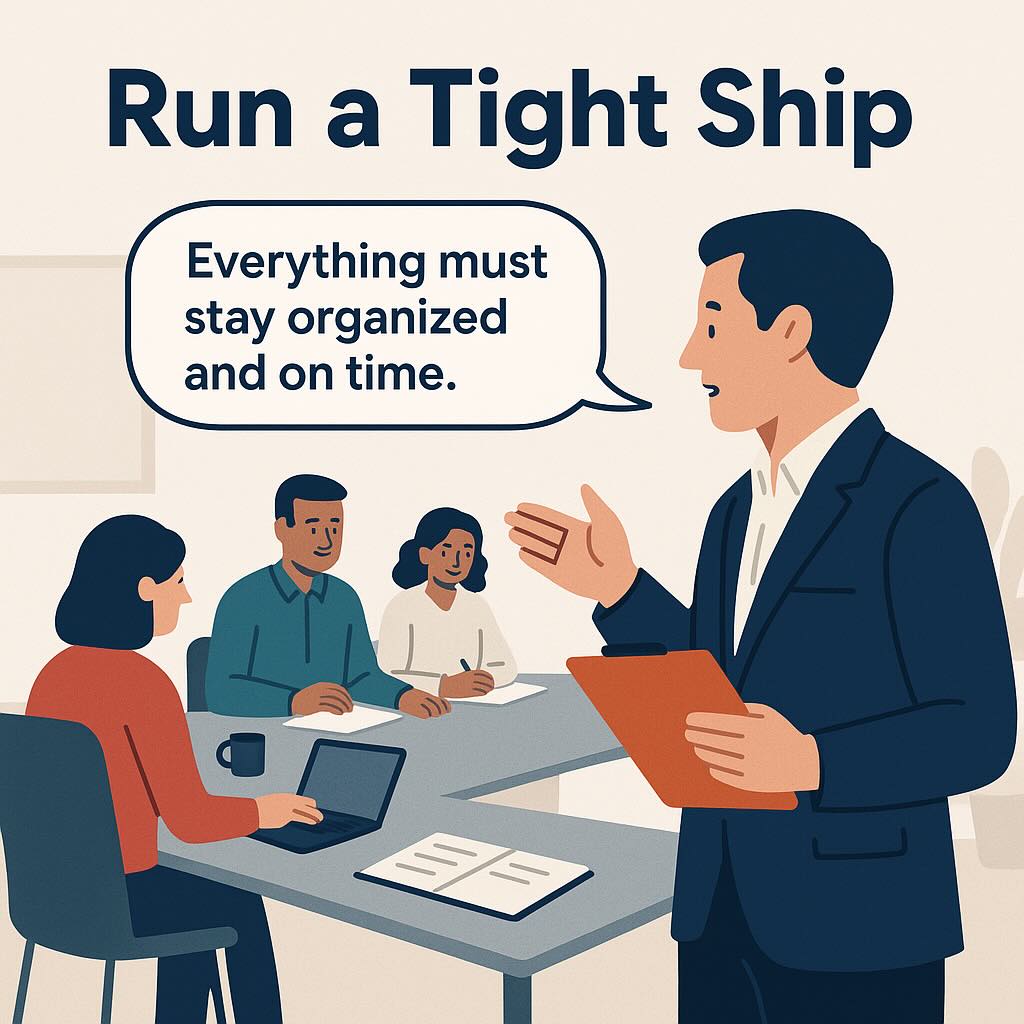
  • Run a Tight Ship


    Run a tight ship meaning

    🗓️ Idiom: Run a Tight Ship (verb)


    💬 Meaning

    • To manage a team, project, or business with strict rules and discipline.
    • To make sure everything is organized and efficient.

    🧠 Example Sentences

    • The project manager runs a tight ship, so deadlines are always met.
    • In our office, the supervisor runs a tight ship, and everyone knows their role.
    • To succeed during the merger, the CEO had to run a tight ship and cut out waste.

    🏛️ Origin

    This idiom comes from the navy, where a “tight ship” meant a vessel with no leaks and a disciplined crew. Over time, it came to mean any organization that is managed with strong control and efficiency.


    📝 Practice Exercises

    1. Fill in the blank:
    The new department head is known to __________, making sure everyone follows the rules.

    Answer

    run a tight ship

    2. Multiple choice:
    What does “run a tight ship” mean?
    a) To relax workplace rules
    b) To manage with discipline and order
    c) To start a new company

    Answer

    b) To manage with discipline and order

    3. Change the sentence using “run a tight ship”:
    “The manager is very strict and makes sure the office is well organized.”

    Answer

    The manager runs a tight ship.


    ℹ️ Other Useful Pages


    📚 Learning Resources

    👉 Main Idioms Page
    👉 Management & Leadership Idioms

    👥 Support Spaces

    👉 Student Space
    👉 Tutor Toolkit

    ⭐️ Extras

    📫 Get a Daily Idiom
    🚀 Build a Business with AI


  • Keep the Ship Afloat


    Keep the Ship Afloat Meaning

    🗓️ Idiom: Keep the Ship Afloat (verb)


    💬 Meaning

    • To keep a project, business, or team running despite problems.
    • To prevent failure or collapse.

    🧠 Example Sentences

    • During the crisis, the team worked hard to keep the ship afloat until help arrived.
    • The finance department cut costs to keep the ship afloat during a slow sales season.
    • Strong teamwork kept the ship afloat while the company searched for a new CEO.

    🏛️ Origin

    This idiom comes from sailing. A ship that takes on too much water will sink, so sailors had to work together to keep it afloat. Over time, the phrase was adopted in business and teamwork to describe keeping an organization or project going, even under stress.


    📝 Practice Exercises

    1. Fill in the blank:
    The new manager introduced strict cost controls to __________ during the economic downturn.

    Answer

    keep the ship afloat

    2. Multiple choice:
    What does “keep the ship afloat” mean?
    a) To plan a new project
    b) To stop something from failing
    c) To expand into new markets

    Answer

    b) To stop something from failing

    3. Change the sentence using “keep the ship afloat”:
    The team made sure the company didn’t collapse during the crisis.

    Answer

    The team worked hard to keep the ship afloat during the crisis.


    ℹ️ Other Useful Pages


    📚 Learning Resources

    👉 Management & Leadership Idioms
    👉 Main Business Idioms List

    👥 Support Spaces

    👉 Student Space
    👉 Tutor Toolkit

    ⭐️ Extras

    📫 Get a Daily Idiom
    🚀 Build a Business with AI


  • Lead by Example


    Lead By Example meaning

    🗓️ Idiom: Lead by Example (verb)


    💬 Meaning

    • To show others how to behave by doing the right thing yourself.
    • To guide a team through your own actions, not just words.

    🧠 Example Sentences

    • The new manager decided to lead by example by arriving early and working hard.
    • Good leaders lead by example instead of only giving orders.
    • She led by example during the project, and the team respected her more.

    🏛️ Origin

    The phrase comes from the idea that true leadership is about action. Instead of telling people what to do, a leader should demonstrate it. It has been used in military and business contexts since at least the 19th century.


    📝 Practice Exercises

    1. Fill in the blank:
    A strong leader should always ________ by example to inspire the team.

    Answer

    lead

    2. Multiple choice:
    What does “lead by example” mean?
    a) To make rules for others but not follow them
    b) To show the right behavior through your own actions
    c) To ignore how others behave

    Answer

    b) To show the right behavior through your own actions

    3. Change the sentence using “lead by example”:
    “She wanted her team to respect her, so she worked hard and was fair to everyone.”

    Answer

    She wanted her team to respect her, so she led by example.


    ℹ️ Other Useful Pages


    📚 Learning Resources

    👉 Management and Leadership Idioms
    👉 Business English Idioms List

    👥 Support Spaces

    👉 Student Space
    👉 Tutor Toolkit

    ⭐️ Extras

    📫 Get a Daily Idiom

    🚀 Build a Business with AI

  • Call the Shots


    Call the Shots meaning

    🗓️ Idiom: Call the Shots (verb)


    💬 Meaning

    • Make the important decisions.
    • To be in control of a situation.

    🧠 Example Sentences

    • In this company, the CEO calls the shots.
    • During the meeting, it was clear that the project manager was calling the shots.
    • He likes to call the shots whenever he works in a team.

    🏛️ Origin

    This idiom comes from the military in the 19th century, where officers would literally “call the shots” during firing drills. Over time, it became a metaphor for being in charge and making key decisions.


    📝 Practice Exercises

    1. Fill in the blank:
    “In our department, the director usually calls the ________.”

    Answer

    shots

    2. Multiple choice:
    What does “call the shots” mean?
    a) To make the key decisions
    b) To take photographs
    c) To play basketball

    Answer

    a) To make the key decisions

    3. Change the sentence using call the shots:
    She is the one who makes all the important decisions in the office.

    Answer

    She is the one who calls the shots in the office.


    ℹ️ Other Useful Pages


    📚 Learning Resources

    👉 Main Idioms Page
    👉 Management & Leadership Idioms

    👥 Support Spaces

    👉 Student Space
    👉 Tutor Toolkit

    ⭐️ Extras

    📫 Get a Daily Idiom
    🚀 Build a Business with AI


  • Business Management Vocabulary


    If you’re managing people, leading projects, or just want to sound more confident at work, knowing the right words really helps. That’s why I’ve created this Business Management Vocabulary list.


    You’ll find 60 useful words and expressions. 20 Beginner, 20 Intermediate, and 20 Advanced level. They’ll help you talk about leadership, planning, teamwork, and decision-making with clarity and confidence.


    👉 Beginner

    👉 Intermediate

    👉 Advanced


    Beginner – Business Management Vocabulary


    WordDefinitionExample Sentence
    leader (n)A person who guides or directs a group.The team leader motivates the team to achieve its goals.
    team (n)A group of people who work together.The team works together to complete the project.
    manager (n)A person who controls or directs a part of an organization.The manager oversees the daily operations of the department.
    employee (n)A person who works for an employer.The employees are responsible for their work.
    supervisor (n)A person who supervises the work of others.The supervisor monitors the progress of the project.
    responsibility (n)A duty or obligation to do something.The leader has the responsibility to guide the team.
    goal (n)An aim or desired result.The team’s goal is to increase sales.
    success (n)Getting the result you want. The leader strives for team success.
    motivation (n)The reason or reasons for acting or behaving in a particular way.The leader provides motivation to the team.
    support (v)To help or assist someone.The leader supports the team in overcoming challenges.
    Beginner – Business Management Vocabulary

    Intermediate – Business Management Vocabulary


    WordDefinitionExample Sentence
    empower (v)To give someone the authority and responsibility to make decisions.Leaders empower their teams to take ownership of their work.
    envision (n)To imagine or see how things could be in the future.A strong leader can envision a successful future for the organisation.
    mentor (n)A person with lots of experience who person who helps a less experienced person. Experienced leaders mentor their team members to help them develop their skills.
    coordinate (v)To organize the various elements of a complex system.Effective managers coordinate the efforts of their team members.
    supervise (v)To watch over a person or activity to ensure it is done correctly.Managers supervise their team members’ work and provide guidance when needed.
    motivate (v)To encourage or create enthusiasm.A good leader motivates their team and makes them want to perform well.
    account (v)To be responsible for one’s actions or the actions of others.Leaders account for the performance of their teams.
    adapt (v)To adjust to new situations. Leaders must adapt to the changing needs of the business.
    innovate (v)To create new products, services, or processes.Leaders encourage their teams to innovate and find new solutions.
    collaborate (v)To work with someone to produce something.Leaders collaborate with their teams to achieve shared goals.
    Intermediate – Business Management Vocabulary

    Advanced -Business Management Vocabulary


    WordDefinitionExample Sentence
    orchestrate (v)To plan and direct the performance of (something complex).The CEO orchestrated a successful company recovery by aligning the efforts of all departments.
    cultivate (v)To help develop (a skill, relationship, or quality).The manager cultivated a positive and productive work environment by fostering open communication and trust.
    mediate (v)To help different parties settle an argument. The manager mediated a conflict between two team members by encouraging a constructive dialogue.
    advocate (v)To recommend or support an idea. The manager advocated for the team’s ideas in the board meeting, presenting a strong case for their adoption.
    strategise (v)To plan a course of action to achieve a major objective.The leadership team strategised to enter new markets by conducting thorough market research before developing a comprehensive marketing plan.
    formulate (v)To create or come up with a plan or system.The manager formulated a new performance evaluation system to identify areas for improvement.
    implement (v)Start a new plan, policy, or procedure. The leader implemented new policies to improve employee engagement. Flexible work arrangements and employee recognition programs were very successful.
    transform (v)Make a very large change to something. The CEO transformed the company from a struggling business into a market leader with intelligent strategies.
    micromanage (v)Manage or control with excessive control or attention to small, unimportant details.The micromanaging manager constantly checked on employees’ work, stifling their creativity and autonomy.
    dismissive (adj)Not paying attention to something. Not taking something seriously. The manager’s dismissive attitude towards the team’s concerns led to low morale and decreased productivity.
    Advanced – Business Management Vocabulary

    ℹ️ Other Useful Pages


    📚 Learning Resources

    👉 Business English Vocabulary List
    👉 Business English Idioms List

    👥 Support Spaces

    👉 Student Space
    👉 Tutor Toolkit

    ⭐️ Extras

    📫 Get a Daily Idiom
    🚀 Build a Business with AI


    We hope our Business Management Vocabulary was helpful.

    “Always treat your employees exactly as you want them to treat your customers.”


  • Management Idioms for Success


    👊 20 Management Idioms for Success


    Hey there! 👋

    Have you ever been in a leadership discussion and heard phrases like “step up to the plate” or “lead by example” and wondered what they really mean?

    You’re not the only one. 😁

    That’s exactly why I created this hub page for Management Idioms for Success.

    It brings together the expressions my students ask about most.

    These management idioms for success appear regularly in:

    • leadership conversations
    • strategy sessions
    • goal-setting discussions

    Once you understand them, management language becomes much clearer.

    You’ll start sounding more confident in professional discussions.

    Each idiom on this page includes:

    • a clear explanation
    • a realistic workplace example
    • a short quiz to help you practice
    • a link to a full idiom page

    You can use this page:

    • as a reference
    • to explore the idioms below
    • to return to it whenever you want
    • to communicate more effectively and confidently as a manager or leader.

    Enjoy the learning and see you in the next lesson!

    Teacher Rob 🙋‍♂️


    👩‍💼 Leadership and Control


    1. 👉 Call the Shots (v)

    Meaning: Make the decisions.
    Example: As CEO, he calls the shots.


    2. 👉 Lead by Example (v)

    Meaning: Show others how to act.
    Example: She leads by example and works hard.


    3. 👉 Steer the Ship (v)

    Meaning: Guide an organisation.
    Example: The manager steered the ship during change.


    4. 👉 Keep the Ship Afloat (v)

    Meaning: Keep a business running.
    Example: They cut costs to keep the ship afloat.


    5. 👉 Run a Tight Ship (v)

    Meaning: Manage very efficiently.
    Example: The team runs a tight ship.


    ✅ Quick Quiz


    1. If someone “calls the shots”, they:


    2. To “lead by example” means to:


    3. A manager who “steers the ship”:


    4. If a company is trying to “keep the ship afloat”, it wants to:


    5. A team that “runs a tight ship”:


    👨‍✈️ Authority and Decision-Making


    6. 👉 In the Driver’s Seat (adj)

    Meaning: In control.
    Example: She is in the driver’s seat on this project.


    7. 👉 Take the Bull by the Horns (v)

    Meaning: Deal with a problem directly.
    Example: He took the bull by the horns.


    8. 👉 Have Many Balls in the Air (v)

    Meaning: Manage many tasks at once.
    Example: She has many balls in the air.


    9. 👉 Hands Are Tied (adj)

    Meaning: Unable to act.
    Example: My hands are tied by company rules.


    10. 👉 Crack the Whip (v)

    Meaning: Use strict control.
    Example: The manager cracked the whip.


    ✅ Quick Quiz


    1. If someone is “in the driver’s seat”, they are:


    2. To “take the bull by the horns” means to:


    3. Someone who “has many balls in the air” is:


    4. If your “hands are tied”, you:


    5. A manager who “cracks the whip”:


    🔨 Tough Management Actions


    11. 👉 Give Someone the Axe (v)

    Meaning: Fire someone.
    Example: The company gave him the axe.


    12. 👉 Show Someone the Door (v)

    Meaning: Make someone leave their job.
    Example: The manager showed him the door.


    13. 👉 Let Someone Go (v)

    Meaning: End someone’s employment.
    Example: They had to let staff go.


    14. 👉 Rule with an Iron Fist (v)

    Meaning: Control very strictly.
    Example: He ruled with an iron fist.


    15. 👉 Pass the Buck (v)

    Meaning: Avoid responsibility.
    Example: She tried to pass the buck.


    ✅ Quick Quiz


    1. If a company “gives someone the axe”, it:


    2. To “show someone the door” means to:


    3. When a company “lets someone go”, it:


    4. A leader who “rules with an iron fist”:


    5. If someone tries to “pass the buck”, they:


    👮‍♂️ Taking Responsibility and Transition


    16. 👉 Sweep Something Under the Rug (v)

    Meaning: Hide a problem.
    Example: The issue was swept under the rug.


    17. 👉 Throw Someone Under the Bus (v)

    Meaning: Blame someone to protect yourself.
    Example: He threw his colleague under the bus.


    18. 👉 Pass the Torch (v)

    Meaning: Give leadership to someone else.
    Example: She passed the torch to her successor.


    19. 👉 Hand Over the Reins (v)

    Meaning: Give up control.
    Example: The founder handed over the reins.


    20. 👉 Hand Over the Keys (v)

    Meaning: Give control or responsibility to someone else.

    Example: The founder handed over the keys to the new CEO.


    ✅ Quick Quiz


    1. If a manager “sweeps a problem under the rug”, they:


    2. To “throw someone under the bus” means to:


    3. When a leader “passes the torch”, they:


    4. If someone “hands over the reins”, they:


    5. To “hand over the keys” is to:


    Did you get 100%?


    Conclusion

    There you go —

    A practical set of management idioms for success you can start recognising and using right away.

    You’ll soon notice these expressions in:

    • team meetings
    • performance reviews
    • leadership discussions

    Now you’ll understand exactly what they mean and how to use them naturally in professional situations.

    Which was your favourite?

    My personal favourite is “call the shots” because it clearly shows someone in control.

    Let me know your favourite in the comments below.

    I always enjoy hearing from you.

    Ready to continue learning?

    Explore our other idiom guides covering:

    👉 Visit my A-Z idiom category page to see more.

    Happy learning,

    Teacher Rob 🙋‍♂️


    Need help learning the idioms?

    Check out my 👉 Best Way to Learn Idioms Quickly Page


    ℹ️ Other Useful Pages


    📚 Learning Resources

    👉 Business English Idioms List

    👥 Support Spaces

    👉 Student Space
    👉 Tutor Toolkit

    ⭐️ Extras

    📫 Get a Daily Idiom