Category: Business Idioms & Phrasal Verbs

  • Get The Show on The Road


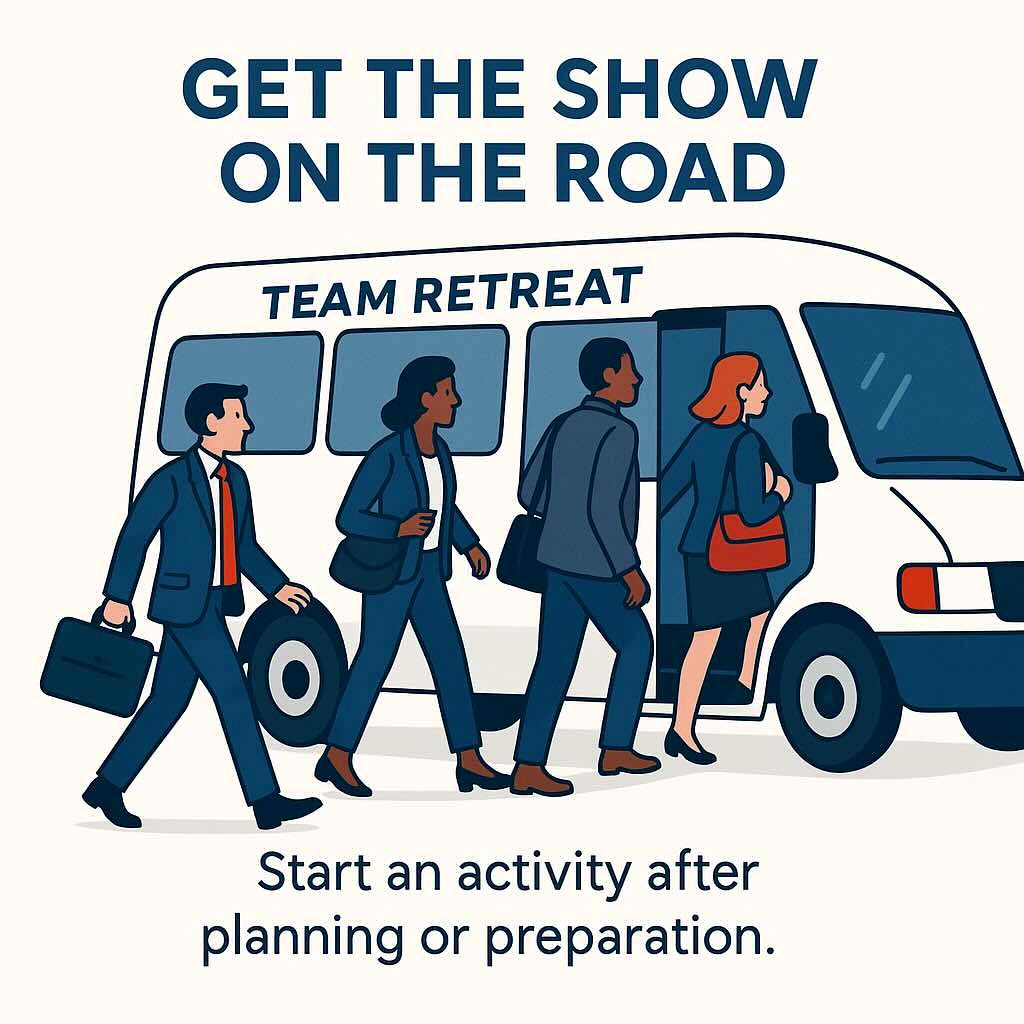
    Get The Show on The Road

    🗓️ Idiom: Get the Show on the Road (v)


    💬 Meaning

    • To begin an activity after preparing for it.
    • To start something officially or finally move forward.

    🧠 Example Sentences

    • We’ve done all the planning—let’s get the show on the road!
    • The manager asked if we were ready to get the show on the road.
    • After weeks of delay, it’s time to get the show on the road.

    🏛️ Origin

    This idiom originally referred to travelling performers who needed to pack up and move to a new town to perform. Today, it means starting a project or event after everything is prepared.


    📝 Practice Exercises

    1. Fill in the blank:

    We’ve planned everything carefully—now let’s __________.

    Answer

    get the show on the road

    2. Choose the correct meaning of “get the show on the road”:

    A) To delay a decision
    B) To begin something after preparing
    C) To cancel a meeting

    Answer

    B) To begin something after preparing

    3. Rewrite the sentence using “get the show on the road”

    “We are ready to begin the project now.”

    Answer

    We’re ready to get the show on the road.


    ℹ️ Other Useful Pages


    📚 Learning Resources
    👉 Business Meetings Idioms
    👉 Business English Idioms List

    👥 Support Spaces
    👉 Student Space
    👉 Tutor Toolkit

    ⭐️ Extras
    📫 Get a Daily Idiom
    🚀 Build a Business with AI

  • Kick Things Off


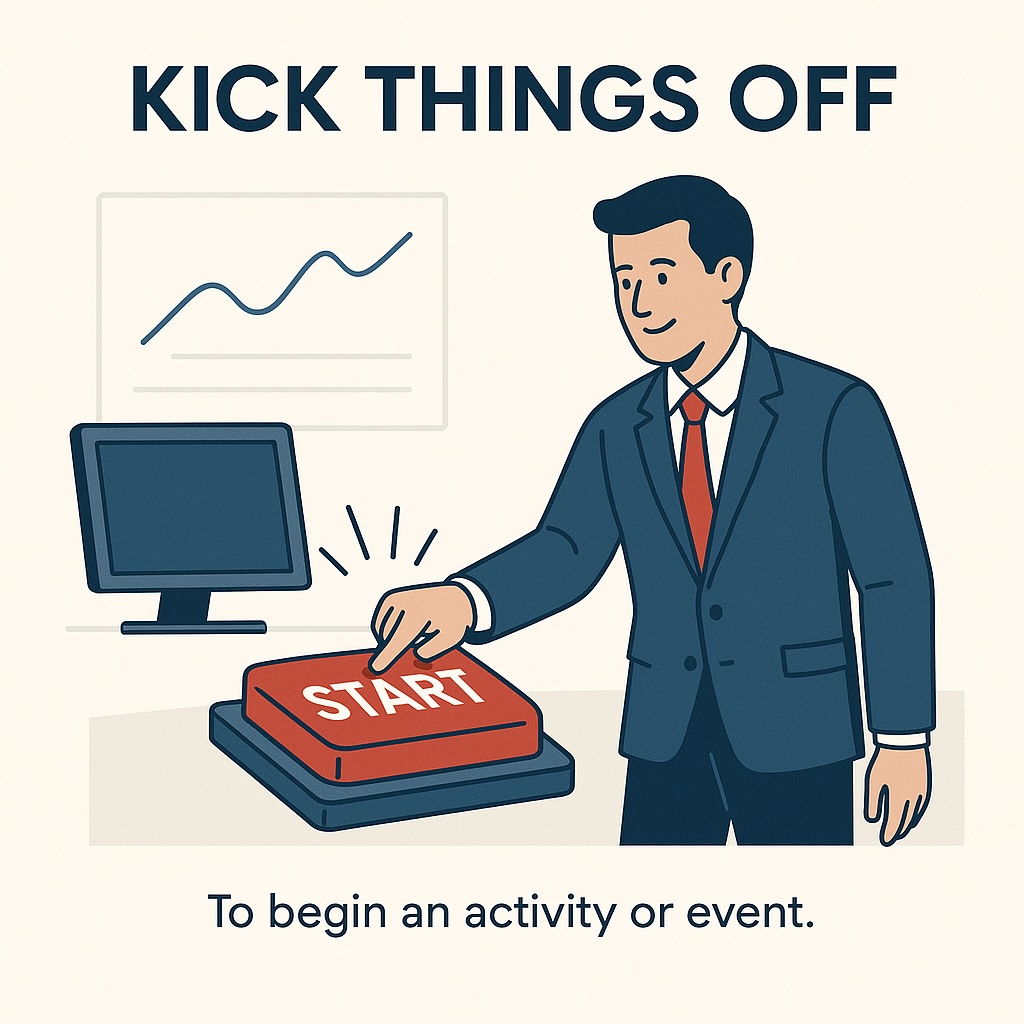
    🗓️ Idiom: Kick Things Off (v)


    💬 Meaning

    • To begin a meeting, event, or process.
    • To start something officially or with energy.

    🧠 Example Sentences

    • Let’s kick things off with a quick review of last week’s meeting.
    • The manager kicked things off by welcoming the new team members.
    • They kicked off the project with a team lunch and planning session.

    🏛️ Origin

    This idiom comes from sports, especially football (soccer or American football), where the game starts with a “kick-off.” In business, it now means to begin any activity or event.


    📝 Practice Exercises

    1. Fill in the blank:

    Let’s __________ with the sales results from last quarter.

    Answer

    kick things off

    2. Choose the correct meaning of “kick things off”:

    A) To stop something
    B) To delay a decision
    C) To start an activity or meeting

    Answer

    C) To start an activity or meeting

    3. Rewrite the sentence using “kick things off”:

    “We began the meeting with a short presentation.”

    Answer

    We kicked things off with a short presentation.


    ℹ️ Other Useful Pages


    📚 Learning Resources
    👉 Business Meetings Idioms
    👉 Business English Idioms List

    👥 Support Spaces
    👉 Student Space
    👉 Tutor Toolkit

    ⭐️ Extras
    📫 Get a Daily Idiom
    🚀 Build a Business with AI


  • Set the Stage


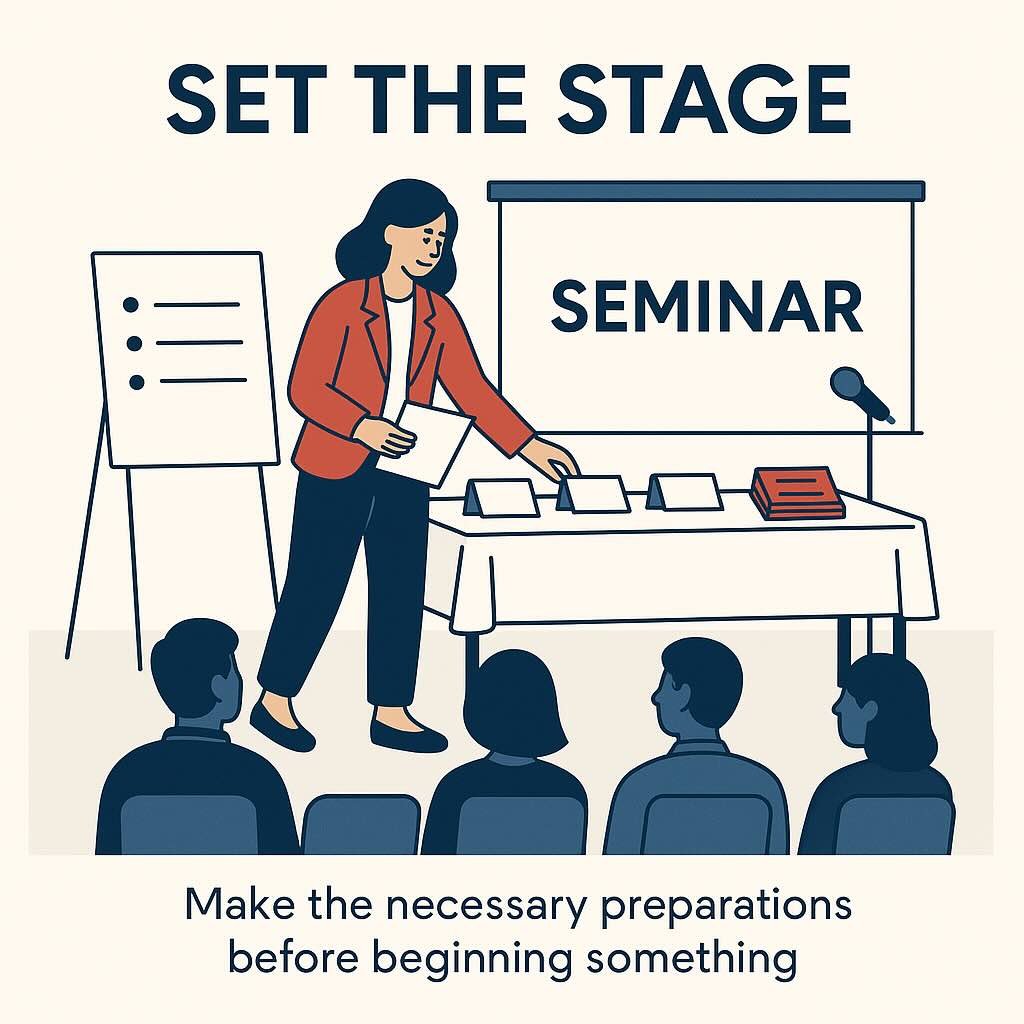
    🗓️ Idiom: Set the Stage (v)


    💬 Meaning

    • To prepare everything needed for something to happen.
    • To create the right conditions for success or the next step.

    🧠 Example Sentences

    • The opening speech set the stage for a productive meeting.
    • The report set the stage for the final decision.
    • She set the stage for the meeting by making sure all the equipment was ready.

    🏛️ Origin

    This idiom comes from the theatre. Before a play begins, the crew “sets the stage” by arranging lights, props, and scenery. In business, it means getting everything ready before the main event or action begins.


    📝 Practice Exercises

    1. Fill in the blank:

    The introduction helped __________ for a productive discussion.

    Answer

    set the stage

    2. Choose the correct meaning of “set the stage”:

    A) To cancel a meeting
    B) To prepare for something to happen
    C) To avoid making a decision

    Answer

    B) To prepare for something to happen

    3. Rewrite the sentence using “set the stage”:

    “The opening slides created the right mood for the strategy session.”

    Answer

    The opening slides set the stage for the strategy session.


    ℹ️ Other Useful Pages


    📚 Learning Resources
    👉 Business Meetings Idioms
    👉 Business English Idioms List

    👥 Support Spaces
    👉 Student Space
    👉 Tutor Toolkit

    ⭐️ Extras
    📫 Get a Daily Idiom
    🚀 Build a Business with AI


  • Job Interview Idioms Explained


    🧑‍💼 20 Job Interview Idioms Explained


    Hey there! 👋

    Have you ever been in a job interview, or preparing for one, and heard phrases like “hit the ground running” or “raise the bar”, and thought, “What do those really mean?”

    You’re definitely not alone. 😁

    That’s exactly why I’ve created this “Job Interview Idioms Explained” hub page.

    It brings together the expressions my students ask about most.

    This Job Interview Idioms page shows you 20 common expressions used when talking about:

    • Interviews
    • Recruiter conversations
    • Career advice
    • Job offers

    Once you understand them, interview situations become much easier.

    You’ll be able to understand expectations more clearly and communicate more confidently and professionally.

    Each idiom on this page includes:

    • a simple explanation
    • a real workplace example
    • a quick quiz to help you practise
    • a link to a full idiom page

    You can use this page:

    • as a reference
    • to explore the idioms below
    • to return to whenever you want to feel more confident in job interview situations

    Enjoy the lesson and I hope to see you in the next one!

    Teacher Rob 🙋‍♂️


    😰 Nervousness and Pressure


    1. 👉 Have Butterflies in Your Stomach (v)

    Meaning: Feel nervous.
    Example: I had butterflies in my stomach before the interview.


    2. 👉 In the Hot Seat (adj)

    Meaning: In a difficult situation.
    Example: I felt in the hot seat during tough questions.


    3. 👉 Put on the Spot (v)

    Meaning: Asked suddenly without time to prepare.
    Example: I was put on the spot with an unexpected question.


    4. 👉 Under the Microscope (adj)

    Meaning: Watched very closely.
    Example: I felt under the microscope during the interview.


    5. 👉 Up Against the Wall (adj)

    Meaning: In a very difficult situation.
    Example: I was up against the wall when I forgot an answer.


    ✅ Quick Quiz


    1. If you “have butterflies in your stomach”, you feel:


    2. If you are “in the hot seat”, you are:


    3. If someone “puts you on the spot”, they:


    4. If you feel “under the microscope”, you feel:


    5. If you are “up against the wall”, you are:


    ⁉️ Heavy Questioning


    6. 👉 Being Grilled (v)

    Meaning: Asked many difficult questions.
    Example: I was grilled about my work experience.


    7. 👉 Given the Third Degree (v)

    Meaning: Questioned very strongly.
    Example: They gave me the third degree about my skills.


    8. 👉 Face the Music (v)

    Meaning: Accept a bad result.
    Example: I had to face the music after the interview.


    9. 👉 Go in Blind (v)

    Meaning: Entering without information.
    Example: I went in blind to the interview without research.


    10. 👉 Wing It (v)

    Meaning: Do something without preparation.
    Example: I tried to wing it and failed.


    ✅ Quick Quiz


    6. If you are “being grilled”, you are:


    7. If someone “gives you the third degree”, they:


    8. To “face the music” means to:


    9. If you “go in blind”, you:


    10. If you “wing it”, you:


    🎒 Preparation and Control


    11. 👉 Have Your Ducks in a Row (v)

    Meaning: Be well prepared.
    Example: I had my ducks in a row before the interview.


    12. 👉 Do Your Homework (v)

    Meaning: Prepare and research carefully.
    Example: I did my homework on the company.


    13. 👉 On Top of Things (adj)

    Meaning: In control and prepared.
    Example: I felt on top of things during the interview.


    14. 👉 Come Across Well (v)

    Meaning: Make a good impression.
    Example: I tried to come across well.


    15. 👉 Hit It Out of the Park (v)

    Meaning: Do very well.
    Example: She hit it out of the park in the interview.


    ✅ Quick Quiz


    11. If you “have your ducks in a row”, you are:


    12. To “do your homework” before an interview means to:


    13. If you are “on top of things”, you are:


    14. If you “come across well” in an interview, you:


    15. To “hit it out of the park” means to:


    🏁 Results and Outcomes


    16. 👉 A Train Wreck (n)

    Meaning: A complete failure.
    Example: The interview was a train wreck.


    17. 👉 A Bomb (n)

    Meaning: A total failure.
    Example: My interview was a bomb.


    18. 👉 A Lost Cause (n)

    Meaning: No chance of success.
    Example: I felt the interview was a lost cause.


    19. 👉 Nail It (v)

    Meaning: Do something perfectly.
    Example: I nailed the interview.


    20. 👉 To Ace Something (v)

    Meaning: Do extremely well.
    Example: She aced the interview.


    ✅ Quick Quiz


    16. If an interview was “a train wreck”, it was:


    17. If your presentation was “a bomb”, it was:


    18. If something feels like “a lost cause”, it means:


    19. If you “nail” the interview, you:


    20. If you “ace” something, you:


    There you go: a great set of Job Interview Idioms explained that you can start using right away!

    I promise you’ll spot these in:

    • your next interview
    • a recruiter call
    • a career chat

    And now you’ll know exactly what they mean, and how to drop them into conversation yourself.

    Which one surprised you the most?

    My favourite is “hit the ground running”, it shows you’re ready to dive in and start a job.

    Let me know your favourite in the comments below.

    I always love hearing from you.

    Ready for more?

    Check out our other idiom guides for:

    Go to my  👉 A-Z List of idiom categories to see more.

    Happy learning,

    Teacher Rob 🙋‍♂️

    Need help learning the idioms?

    Check out my 👉 Best Way to Learn Idioms Quickly Page


    ℹ️ Other Useful Pages


    📚 Learning Resources

    👉 Business English Vocabulary List
    👉 Business English Idioms List

    👥 Support Spaces

    👉 Student Space
    👉 Tutor Toolkit

    ⭐️ Extras

    📫 Get a Daily Idiom


    We hope you enjoyed our Job Interview Idioms Explained page.


  • Conflict Resolution Idioms Examples


    🤝 20 Conflict Resolution Idioms Examples


    Hey there! 👋

    Have you ever been in a tense team discussion and heard phrases like “clear the air” or “bury the hatchet”, and thought, “What does that really mean?”

    You’re definitely not alone. 😁

    That’s exactly why I’ve created this “Conflict Resolution Idioms Examples” hub page.

    It brings together the expressions my students ask about most.

    This Conflict Resolution Idioms page shows you 20 common expressions used when talking about:

    • Tricky conversations
    • Mediation sessions
    • Feedback meetings
    • Team check-ins

    Once you understand them, handling disagreements becomes much easier.

    You’ll be able to navigate difficult conversations more smoothly and communicate more professionally.

    Each idiom on this page includes:

    • a simple explanation
    • a real workplace example
    • a quick quiz to help you practise
    • a link to a full idiom page

    You can use this page:

    • as a reference
    • to practise the idioms at your own pace
    • to return to whenever you need help handling disagreements at work

    Enjoy the lesson and I hope to see you in the next one!

    Teacher Rob 🙋‍♂️


    😱 Being in Conflict or Disagreement


    1. 👉 At Odds With Someone or Something (Adj)

    Meaning: In disagreement or conflict.
    Example: The two departments were at odds over priorities.


    2. 👉 At Loggerheads (Adj)

    Meaning: Strongly disagreeing with no progress.
    Example: Management and staff were at loggerheads over pay.


    3. 👉 Lock Horns (V)

    Meaning: Argue strongly with someone.
    Example: The managers locked horns over budgets.


    4. 👉 Cross Swords (V)

    Meaning: Enter into an argument or conflict.
    Example: HR crossed swords with IT over the new system.


    5. 👉 Clash Heads (V)

    Meaning: Disagree strongly.
    Example: The executives clashed heads on company strategy.


    ✅ Quick Quiz


    1. If two teams are at odds with each other, they are:


    2. When people are at loggerheads, they are:


    3. If two managers lock horns, they:


    4. When departments cross swords, they:


    5. If executives clash heads, they:


    🥵 Rising Tension and Anger


    6. 👉 At Each Other’s Throats (Adj)

    Meaning: In a state of intense conflict.
    Example: The teams were at each other’s throats after the delay.


    7. 👉 Be on a Collision Course (V)

    Meaning: Heading toward conflict.
    Example: Old policies and new demands were on a collision course.


    8. 👉 Have a Chip on One’s Shoulder (V)

    Meaning: Be easily offended due to past issues.
    Example: He had a chip on his shoulder after being overlooked.


    9. 👉 Tread on Someone’s Toes (V)

    Meaning: Accidentally offend someone.
    Example: She tread on a colleague’s toes during the meeting.


    10. 👉 See Red (V)

    Meaning: Become very angry.
    Example: The manager saw red when the deadline was missed.


    ✅ Quick Quiz


    6. If two teams are at each other’s throats, they are:


    7. If two groups are on a collision course, they are:


    8. If someone has a chip on their shoulder, they:


    9. If you tread on someone’s toes, you:


    10. If a manager sees red, they:


    🔒 Deadlock and Ongoing Problems


    11. 👉 Be at a Stalemate (Adj)

    Meaning: No side can move forward.
    Example: Talks were at a stalemate over costs.


    12. 👉 A Vicious Cycle (N)

    Meaning: A repeating negative pattern.
    Example: Low morale created a vicious cycle of poor results.


    13. 👉 Stuck in a Rut (Adj)

    Meaning: Unable to change an unproductive situation.
    Example: The team felt stuck in a rut.


    14. 👉 Let Sleeping Dogs Lie (V)

    Meaning: Avoid restarting a settled conflict.
    Example: Management chose to let sleeping dogs lie.


    15. 👉 Move On (V)

    Meaning: Accept the past and continue forward.
    Example: After the dispute, the team decided to move on.


    🕊️ Resolving Conflict and Making Peace


    ✅ Quick Quiz


    11. If talks are at a stalemate, it means:


    12. A vicious cycle is:


    13. If a team is stuck in a rut, they are:


    14. If you let sleeping dogs lie, you:


    15. To move on after a dispute means to:


    16. 👉 Bury the Hatchet (V)

    Meaning: End a conflict and make peace.
    Example: The departments buried the hatchet.


    17. 👉 Call a Truce (V)

    Meaning: Agree to stop arguing.
    Example: The CEO called a truce to refocus the team.


    18. 👉 Let Bygones Be Bygones (V)

    Meaning: Forget past conflicts.
    Example: Staff were encouraged to let bygones be bygones.


    19. 👉 Shake Hands and Make Up (V)

    Meaning: Reconcile after an argument.
    Example: The colleagues shook hands and made up.


    20. 👉 Patch Things Up (V)

    Meaning: Repair a damaged relationship.
    Example: Leaders worked hard to patch things up.


    ✅ Quick Quiz


    16. If two departments bury the hatchet, they:


    17. If leaders call a truce, they:


    18. If people let bygones be bygones, they:


    19. If colleagues shake hands and make up, they:


    20. If managers try to patch things up, they:


    Did you get 100%?


    There you go – a great set of Conflict Resolution Idioms with examples you can start using right away!

    I promise you’ll spot these in:

    • your next disagreement
    • a feedback session
    • a team huddle

    And now you’ll know exactly what they mean, and how to drop them in yourself.

    Which one surprised you the most?

    My favourite is “bury the hatchet.” I like the idea of putting something under the ground and forgetting it forever.

    Let me know your favourite in the comments below — I always enjoy hearing from you.

    Ready for more?

    Check out our other idiom guides for:

    Go to my  👉 A-Z List of idiom categories to see more.

    Happy learning,

    Teacher Rob 🙋‍♂️


    Need help learning the idioms?

    Check out my 👉 Best Way to Learn Idioms Quickly Page


    ℹ️ Other Useful Pages


    📚 Learning Resources

    👉 Business English Idioms List

    👥 Support Spaces

    👉 Student Space
    👉 Tutor Toolkit

    ⭐️ Extras

    📫 Get a Daily Idiom


    We hope you enjoyed our Conflict and Conflict Resolution Idioms.


  • Top Idioms for Business Complaints


    🥴 20 Top Idioms for Business Complaints


    Hey there! 👋

    Have you ever read a complaint email and seen phrases like “not up to scratch” or “raise an issue” and then wondered what they really mean?

    You’re not the only one. 😁

    That’s exactly why I’ve created this “Top Idioms for Business Complaints” hub page.

    It brings together the expressions my students ask about most.

    This Top Idioms for Business Complaints page shows you 20 common expressions used when talking about:

    • Customer service conversations
    • Internal feedback
    • Formal emails
    • Problem-resolution discussions

    Once you understand them, handling complaints becomes much easier.

    You’ll be able to communicate concerns more confidently and professionally.

    Each idiom on this page includes:

    • a clear explanation
    • a realistic workplace example
    • a quiz to help you practise
    • a link to a full idiom page

    You can use this page:

    • as a reference
    • to explore the idioms below
    • to return to it whenever you need to raise or respond to complaints more effectively in English

    Enjoy the lesson and I hope to see you in the next one!

    Teacher Rob 🙋‍♂️


    🗣️ Expressing Complaints Clearly and Firmly


    1. 👉 State Your Case (V)

    Meaning: Explain your reasons clearly and calmly.
    Example: I stated my case to my boss about why the process needed to change.


    2. 👉 Voice Your Concerns (V)

    Meaning: Say what worries or upsets you.
    Example: The customer voiced their concerns about the delayed delivery.


    3. 👉 Lodge A Complaint (V)

    Meaning: Officially make a complaint.
    Example: She lodged a complaint with HR.


    4. 👉 Put Your Foot Down (V)

    Meaning: Be firm and refuse to accept something.
    Example: The manager put her foot down about missed deadlines.


    5. 👉 Give Someone a Piece of Your Mind (V)

    Meaning: Speak very directly and angrily to someone.
    Example: The client gave the supplier a piece of his mind about the mistake.


    ✅ Quick Quiz


    1. If you state your case, you:


    2. If you voice your concerns, you:


    3. If you lodge a complaint, you:


    4. If a manager puts their foot down, they:


    5. If you give someone a piece of your mind, you:


    🙀 Emotional Situation Complaints


    6. 👉 Make a Scene (V)

    Meaning: Behave loudly or angrily in public.
    Example: The customer made a scene at the service desk.


    7. 👉 Kick Up a Fuss (V)

    Meaning: Complain loudly or cause trouble.
    Example: He kicked up a fuss about the incorrect invoice.


    8. 👉 Make a Mountain Out of a Molehill (V)

    Meaning: Overreact to a small problem.
    Example: She made a mountain out of a molehill over a minor error.


    9. 👉 Cry Over Spilled Milk (V)

    Meaning: Complain about something that cannot be changed.
    Example: There’s no point crying over spilled milk, let’s fix it.


    10. 👉 Walk on Eggshells (V)

    Meaning: Speak very carefully because someone might get upset or angry.
    Example: Everyone was walking on eggshells around the angry client.


    ✅ Quick Quiz


    1. If someone makes a scene, they:


    2. If someone kicks up a fuss, they:


    3. If someone makes a mountain out of a molehill, they:


    4. If someone cries over spilled milk, they:


    5. If people walk on eggshells, they:


    🙈 Softening Complaints


    11. 👉 Tiptoe Around Something (V)

    Meaning: Avoid speaking directly about a problem.
    Example: He kept tiptoeing around the real issue.


    12. 👉 Dance Around the Subject (V)

    Meaning: Avoid talking directly about something.
    Example: The manager danced around the subject of pay cuts.


    13. 👉 Sugarcoat Something (V)

    Meaning: Make bad news sound better than it is.
    Example: She sugarcoated the delay to calm the client.


    14. 👉 Break it to Someone Gently (V)

    Meaning: Explain something carefully to try and not shock or hurt somebody.
    Example: The manager broke it to the team gently that there had been many complaints.


    15. 👉 Beat around the Bush (V)

    Meaning: Avoid talking about an important topic.
    Example: The service agent kept beating around the bush instead of fixing the problem.


    ✅ Quick Quiz


    1. If someone tiptoes around something, they:


    2. If someone dances around the subject, they:


    3. If someone sugarcoats something, they:


    4. If you break it to someone gently, you:


    5. If someone beats around the bush, they:


    😡 Losing Your Temper


    16. 👉 Hit the Roof (V)

    Meaning: Become very angry.
    Example: The boss hit the roof when she saw the report.


    17. 👉 Go Ballistic (V)

    Meaning: Become extremely angry.
    Example: The customer went ballistic over the mistake.


    18. 👉 Blow Your Top (V)

    Meaning: Suddenly lose your temper.
    Example: He blew his top when the deadline was missed.


    19. 👉 Fly Off the Handle (V)

    Meaning: Get angry very quickly.
    Example: She flew off the handle during the call.


    20. 👉 Lose Your Cool (V)

    Meaning: Stop controlling your emotions.
    Example: The manager lost his cool in front of the team.


    ✅ Quick Quiz


    1. If someone hits the roof, they:


    2. If someone goes ballistic, they:


    3. If someone blows their top, they:


    4. If someone flies off the handle, they:


    5. If someone loses their cool, they:


    There you go — a practical collection of Top Idioms for Business Complaints you can start recognising and using right away.

    You’ll soon notice these expressions in:

    • complaint emails
    • customer conversations
    • internal reports
    • service recovery discussions

    Now you’ll understand exactly what they mean and how to use them appropriately in professional contexts.

    Which complaint idiom do you like the most?

    My favourite is “don’t cry over spilt milk.” It describes that there is no point in getting upset over small things.

    Let me know in the comments below which one you like.

    I always enjoy hearing about real workplace situations from learners.

    Ready to continue learning?

    You can explore my other idiom guides covering:

    👉 Go to my A–Z list of idiom categories to see more.

    Happy learning,

    Teacher Rob 🙋‍♂️

    Need help learning the idioms?

    Check out my 👉 Best Way to Learn Idioms Quickly Page


    ℹ️ Other Useful Pages


    📚 Learning Resources

    👉 Business English Idioms List

    👥 Support Spaces

    👉 Student Space
    👉 Tutor Toolkit

    ⭐️ Extras

    📫 Get a Daily Idiom


    We hope you enjoyed our Idioms For Complaints


  • Workplace Humour Idioms


    20 Workplace Humour Idioms


    Hey there! 👋

    Have you ever been in an office chat or meeting and heard phrases like “pull someone’s leg” or “have a laugh” and wondered what they really mean?

    You’re not the only one. 😁

    That’s exactly why I’ve created this Workplace Humour Idioms hub page.

    It brings together the expressions my students ask about most.

    This Workplace Humour Idioms page shows you 20 common expressions used when talking about:

    • Light-hearted banter
    • Informal conversations
    • Friendly emails at work

    Once you understand them, workplace humour becomes much clearer.

    You’ll get the jokes more easily and feel more comfortable joining in with the team.

    Each idiom on this page includes:

    • a clear explanation
    • a realistic workplace example
    • a short quiz to help you practise
    • a link to a full idiom page

    You can use this page:

    • as a reference
    • to explore the idioms below
    • to return to it whenever you want to understand workplace humour more naturally in English

    Enjoy the lesson and I hope to see you in the next one!

    Teacher Rob 🙋‍♂️


    🤪 Acting Silly to Entertain Others


    1. 👉 Play the Fool (v)

    Meaning: Act silly to make people laugh.
    Example: He played the fool at the office party.


    2. 👉 Play the Clown (v)

    Meaning: Act silly to amuse others.
    Example: He played the clown to relax the team.


    3. 👉 Be a Joker (n)

    Meaning: A person who likes telling jokes.
    Example: She is a joker in the office.


    4. 👉 A Wag (n)

    Meaning: Someone who enjoys joking.
    Example: The office wag made everyone laugh.


    5. 👉 Be a Prankster (n)

    Meaning: Someone who plays jokes on others.
    Example: He is known as the office prankster.


    ✅ Quick Quiz


    1. What does “play the fool” mean?


    2. If someone plays the clown, they:


    3. What is a joker in the office?


    4. What does a wag describe?


    5. A prankster is someone who:


    😹 PlayfulTeasing and Joking


    6. 👉 Pull Someone’s Leg (v)

    Meaning: Joke or tease someone.
    Example: She pulled his leg about the report.


    7. 👉 Take the Mickey (v)

    Meaning: Make fun of someone playfully.
    Example: They took the mickey out of his haircut.


    8. 👉 Poke Fun at Someone (v)

    Meaning: Make gentle jokes about someone.
    Example: They poked fun at his new desk.


    9. 👉 A Ribbing (n)

    Meaning: Friendly teasing.
    Example: A little ribbing helped the team relax.


    10. 👉 Have Banter (v)

    Meaning: Exchange playful jokes.
    Example: The team enjoys friendly banter.


    ✅ Quick Quiz


    6. If you pull someone’s leg, you:


    7. If coworkers take the mickey, they:


    8. If people poke fun at someone, they:


    9. What is a ribbing?


    10. If coworkers have banter, they:


    🎭 Jokes, Pranks, and Light Moments


    11. 👉 Play a Prank on Someone (v)

    Meaning: Trick someone as a joke.
    Example: They played a prank on the manager.


    12. 👉 A Wind-up (n)

    Meaning: A playful trick.
    Example: The prank was just a wind-up.


    13. 👉 Share a Joke (v)

    Meaning: Tell a joke to others.
    Example: He shared a joke during the meeting.


    14. 👉 Make Light of Something (v)

    Meaning: Treat a serious thing humorously.
    Example: She made light of the mistake.


    15. 👉 Give Someone a Hard Time (v)

    Meaning: Tease someone playfully.
    Example: They gave him a hard time on his first day.


    ✅ Quick Quiz


    11. If coworkers play a prank on someone, they:


    12. What is a wind-up?


    13. If you share a joke, you:


    14. If someone makes light of something, they:


    15. If coworkers give someone a hard time, they:


    ⚠️ Humour That Can Go Too Far


    16. 👉 A Laugh at Someone’s Expense (n)

    Meaning: Laughing by embarrassing someone.
    Example: It is wrong to laugh at someone’s expense.


    17. 👉 To Needle Someone (v)

    Meaning: Tease someone again and again.
    Example: He kept needling his coworker.


    18. 👉 Put Someone Down (v)

    Meaning: Criticise or insult someone.
    Example: Putting people down hurts teamwork.


    19. 👉 Give Someone a Hard Time (v)

    Meaning: Repeated teasing.
    Example: The jokes gave her a hard time.


    20. 👉 Roast someone (V)

    Meaning: Make strong jokes about someone, often to embarrass them.
    Example: His coworkers roasted him about his messy desk.


    ✅ Quick Quiz


    16. If something is a laugh at someone’s expense, it:


    17. If someone needles a coworker, they:


    18. If someone puts someone down, they:


    19. If coworkers give someone a hard time, they:


    20. If coworkers roast someone, they:


    There you go — a practical set of Workplace Humour Idioms you can start recognising and using right away.

    You’ll soon notice these expressions in:

    • office chats
    • team lunches
    • informal meetings
    • friendly emails

    Now you’ll understand exactly what they mean and how to use them appropriately in professional settings.

    Which idiom stood out to you the most?

    My personal favourite is “pull someone’s leg” because it’s such a classic example of friendly teasing at work.

    Let me know your favourite in the comments below.

    I always enjoy hearing from you.

    Ready to continue learning?

    Explore our other idiom guides covering:

    Check out my 👉 A-Z idiom category list to see more.

    Happy learning,

    Teacher Rob 🙋‍♂️


    Need help learning the idioms?

    Check out my 👉 Best Way to Learn Idioms Quickly Page


    ℹ️ Other Useful Pages


    📚 Learning Resources

    👉 Business English Idioms List

    👥 Support Spaces

    👉 Student Space
    👉 Tutor Toolkit

    ⭐️ Extras

    📫 Get a Daily Idiom


    We hope you enjoyed our Workplace Humour Idioms.


  • Idioms For Different Work Styles


    👨‍💼 20 Idioms For Different Work Styles


    Hey there! 👋

    Have you ever worked with someone who “likes to take the lead” or prefers to “work behind the scenes” and wondered what those phrases really mean?

    You’re definitely not alone. 😁

    That’s exactly why I’ve created this Idioms for Different Work Styles hub page.

    It brings together the expressions my students ask about most.

    This Idioms for Different Work Styles page shows you 20 common expressions used when talking about:

    • How people work
    • Collaboration and decision-making
    • Different approaches to tasks

    Once you understand them, it becomes much easier to follow conversations about work styles.

    You’ll be able to discuss team members and their strengths and weaknesses with confidence.

    Each idiom on this page includes:

    • a clear explanation
    • a realistic workplace example
    • a quiz to help you practise
    • a link to a full idiom page

    You can use this page:

    • as a reference
    • to explore the idioms below
    • to return to it whenever you want
    • to talk confidently about different working styles in professional situations

    Go through them at your own pace, try saying them out loud, and enjoy the process!

    Enjoy the lesson and I hope to see you in the next one!

    Teacher Rob 🙋‍♂️


    A Quick Reminder of Work Styles

    • Logical / Analytical : Focuses on facts and data.
    • Detail-oriented: Care about being precise.
    • Supportive : Team player and collaborative
    • Idea-oriented : Thinks about big ideas and big picture.

    🧮 Logical Work Style


    1. 👉 As Straight as an Arrow (adj)

    Meaning: Honest and truthful.
    Example: John is as straight as an arrow. When there’s a problem, he says it right away.


    2. 👉 Level-Headed (adj)

    Meaning: Calm and sensible.
    Example: Sarah is always level-headed. Her calm personality helps in stressful situations.


    3. 👉 Weigh the Pros and Cons (v)

    Meaning: Consider the good and bad points before deciding.
    Example: Maria always weighs the pros and cons before making decisions.


    4. 👉 Data-Driven (adj)

    Meaning: Make decisions based on facts and numbers.
    Example: David is very data-driven. He always checks the numbers before deciding.


    5. 👉 Have Your Head Screwed On (adj)

    Meaning: Be sensible and practical.
    Example: Emily has her head screwed on. She always plans carefully.


    ✅ Quick Quiz


    1. If someone is as straight as an arrow, they are:


    2. If a person is level-headed, they usually:


    3. If you weigh the pros and cons, you:


    4. If someone is data-driven, they:


    5. If someone has their head screwed on, they are:


    📊 Detail-Oriented Work Style


    6. 👉 Be a Perfectionist (adj)

    Meaning: Try to make everything perfect.
    Example: Alex is a perfectionist. He wants everything to be perfect.


    7. 👉 Nitpick (v)

    Meaning: Look for small mistakes.
    Example: Mark always nitpicks. He finds tiny errors that help improve work.


    8. 👉 A Stickler for Details (n)

    Meaning: Care a lot about accuracy.
    Example: Lisa is a stickler for details. She always catches mistakes.


    9. 👉 Split Hairs (v)

    Meaning: Argue about small differences or details.
    Example: Tom likes to split hairs. He argues over tiny points.


    10. 👉 Go Through with a Fine-Tooth Comb (v)

    Meaning: Examine something very carefully.
    Example: Maria goes through the report with a fine-tooth comb to avoid mistakes.


    🐕‍🦺 Supportive Work Style


    ✅ Quick Quiz


    6. If someone is a perfectionist, they want:


    7. If someone likes to nitpick, they:


    8. If someone is a stickler for details, they:


    9. If someone likes to split hairs, they:


    10. If you go through something with a fine-tooth comb, you:


    11. 👉 Shoulder to Cry On (n)

    Meaning: Someone who provides emotional support.
    Example: Sarah is a shoulder to cry on. She helps colleagues when they are stressed.


    12. 👉 Have Someone’s Best Interest at Heart (v)

    Meaning: Care about someone’s well-being.
    Example: David has your best interest at heart. He always thinks of the team.


    13. 👉 A Source of Comfort (n)

    Meaning: Someone or something that makes you feel safe.
    Example: Working with Emily is a source of comfort. She makes the team feel calm.


    14. 👉 Be a Pillar of Strength (n)

    Meaning: Give support and encouragement.
    Example: John is a pillar of strength. He motivates the team during challenges.


    15. 👉 Be a Sounding Board (n)

    Meaning: Someone you can talk to about ideas.
    Example: Maria is a great sounding board. She listens and gives good advice.


    ✅ Quick Quiz


    11. If someone is a shoulder to cry on, they:


    12. If someone has your best interest at heart, they:


    13. If someone is a source of comfort, they:


    14. If someone is a pillar of strength, they:


    15. If someone is a sounding board, they:


    💡Idea Oriented Work Style


    16. 👉 See the Bigger Picture (v)

    Meaning: Understand the whole situation.
    Example: Alex sees the bigger picture. He knows how our work fits the company goals.


    17. 👉 Bird’s-Eye View (n)

    Meaning: A broad perspective.
    Example: Lisa has a bird’s-eye view of the department. She sees how everything connects.


    18. 👉 A Stroke of Genius (n)

    Meaning: A sudden smart idea.
    Example: David had a stroke of genius. He found a quick solution to the problem.


    19. 👉 A Eureka Moment (n)

    Meaning: A sudden discovery or insight.
    Example: Mark had a Eureka moment. He suddenly understood the solution.


    20. 👉 A Fountain of Ideas (n)

    Meaning: Someone who always has new ideas.
    Example: Emily is a fountain of ideas. She comes up with creative solutions all the time.


    ✅ Quick Quiz


    16. If someone sees the bigger picture, they:


    17. If you have a bird’s-eye view, you:


    18. If someone has a stroke of genius, they have:


    19. If someone has a Eureka moment, they:


    20. If someone is a fountain of ideas, they:


    ✅ Quick Quiz


    16. If someone sees the bigger picture, they:


    17. If you have a bird’s-eye view, you:


    18. If someone has a stroke of genius, they have:


    19. If someone has a Eureka moment, they:


    20. If someone is a fountain of ideas, they:


    There you go – a practical collection of Idioms for Different Work Styles you can start recognising and using right away.

    You’ll soon hear these idioms in:

    • team discussions
    • performance reviews
    • project planning conversations

    Now you’ll understand exactly what they mean and how to use them naturally.

    Which one stood out to you the most?

    My personal favourite is “have your head screwed on” because it clearly shows a person thinking the right way.

    Let me know your favourite in the comments below.

    I always enjoy hearing from you.

    Want to keep learning?

    Explore our other idiom guides covering:

    Check out my 👉 A-Z idiom category list to see more.

    Happy learning,

    Teacher Rob 🙋‍♂️


    Need help learning the idioms?

    Check out my 👉 Best Way to Learn Idioms Quickly page.


    ℹ️ Other Useful Pages


    📚 Learning Resources

    👉 Business English Idioms List

    👥 Support Spaces

    👉 Student Space
    👉 Tutor Toolkit

    ⭐️ Extras

    📫 Get a Daily Idiom


    We hope you enjoyed our Idioms For Different Work Styles.


  • Stress Management Idioms


    😥 20 Stress Management Idioms


    Hey there! 👋

    Have you ever been under pressure at work and heard phrases like “under the gun” or “burning the candle at both ends” and thought, “What does that really mean?”

    You’re definitely not alone. 😁

    That’s exactly why I’ve created this Stress Management Idioms hub page.

    It brings together the expressions my students ask about most.

    This Stress Management Idioms page shows you 20 common expressions used when talking about:

    • Pressure
    • Workload
    • Mental strain
    • Coping at work

    Once you understand them, conversations about stress and balance become much clearer.

    You’ll be able to talk about pressure more naturally and confidently in English.

    Each idiom on this page includes:

    • a clear explanation
    • a realistic workplace example
    • a quick quiz to help you practise
    • a link to a full idiom page

    You can use this page:

    • as a reference
    • to explore the idioms below
    • to return to whenever you want to understand stress management phrases

    Go through them at your own pace, try saying them out loud, and enjoy the process!

    Enjoy the lesson and I hope to see you in the next one!

    Teacher Rob 🙋‍♂️


    🧘 Calming Down and Relaxing


    1. 👉 Take a Deep Breath (v)

    Meaning: Calm yourself.
    Example: When I feel stressed at work, I take a deep breath and slow down.


    2. 👉 Let Off Steam (v)

    Meaning: Release stress or anger.
    Example: I go for a walk after work to let off steam.


    3. 👉 Unwind (v)

    Meaning: Relax after stress.
    Example: Watching a film helps me unwind in the evening.


    4. 👉 Take a Load Off (v)

    Meaning: Stop working and relax.
    Example: After a long day, I take a load off and rest.


    5. 👉 Switch Off (v)

    Meaning: Stop thinking about work.
    Example: I try to switch off from emails at night.


    ✅ Quick Quiz


    1. If you take a deep breath, you:


    2. When you let off steam, you:


    3. If you want to unwind, you want to:


    4. If you take a load off, you:


    5. When you switch off, you:


    ⚖️ Healthy Balance and Self-Care


    6. 👉 Get Some Fresh Air (v)

    Meaning: Go outside to feel better.
    Example: I get some fresh air when my head feels full.


    7. 👉 Find a Balance (v)

    Meaning: Create a healthy mix.
    Example: Finding a balance between work and rest reduces stress.


    8. 👉 Take Things Easy (v)

    Meaning: Relax and avoid pressure.
    Example: On weekends, I take things easy.


    9. 👉 Practice Self-Care (v)

    Meaning: Look after your health.
    Example: Good sleep is part of practicing self-care.


    10. 👉 Let Go of (v)

    Meaning: Stop worrying.
    Example: I let go of small problems I cannot control.


    ✅ Quick Quiz


    6. If you get some fresh air, you:


    7. If you find a balance, you:


    8. If you take things easy, you:


    9. If you practice self-care, you:


    10. If you let go of a problem, you:


    😫 Feeling Overwhelmed


    11. 👉 Running on Empty (expr)

    Meaning: Very tired and stressed.
    Example: After weeks of overtime, I was running on empty.


    12. 👉 At Your Wit’s End (expr)

    Meaning: Extremely stressed or frustrated.
    Example: I was at my wit’s end with constant deadlines.


    13. 👉 Treading Water (v)

    Meaning: Just managing, not improving.
    Example: With too much work, I felt like I was treading water.


    14. 👉 In It Up to Your Neck (expr)

    Meaning: Very involved in a difficult situation.
    Example: I was in it up to my neck with tasks.


    15. 👉 Centre Yourself (v)

    Meaning: Calm your mind and focus.
    Example: Deep breathing helps me centre myself.


    ✅ Quick Quiz


    11. If you are running on empty, you feel:


    12. If you are at your wit’s end, you are:


    13. If you are treading water, you are:


    14. If you are in it up to your neck, you are:


    15. If you centre yourself, you:


    😰 Stress Reactions and Pressure


    16. 👉 Like a Fish Out of Water (expr)

    Meaning: Feel uncomfortable or unsure.
    Example: I felt like a fish out of water in my new role.


    17. 👉 Like a Deer in the Headlights (expr)

    Meaning: Feel shocked or frozen.
    Example: I felt like a deer in the headlights during the meeting.


    18. 👉 A Cat on a Hot Tin Roof (expr)

    Meaning: Very nervous or restless.
    Example: Before deadlines, I feel like a cat on a hot tin roof.


    19. 👉 Like a Sitting Duck (expr)

    Meaning: In a weak or exposed position.
    Example: Without support, I felt like a sitting duck.


    20. 👉 A Bull in a China Shop (expr)

    Meaning: Act without care.
    Example: When stressed, he becomes a bull in a china shop.


    ✅ Quick Quiz


    16. If you feel like a fish out of water, you feel:


    17. If you look like a deer in the headlights, you:


    18. If someone is a cat on a hot tin roof, they are:


    19. If you feel like a sitting duck, you feel:


    20. If someone acts like a bull in a china shop, they:


    There you go:

    A useful collection of Stress Management Idioms you can start recognising and using right away.

    You’ll soon notice these idioms in:

    • conversations about deadlines
    • workload discussions
    • work–life balance conversations

    Now you’ll understand exactly what they mean and how to use them naturally.

    Which one stood out to you the most?

    My personal favourite is “let off steam” because I like the idea of steam coming off somebody’s head.

    Let me know your favourite in the comments below.

    I always enjoy hearing from you.

    Want to keep learning?

    Explore our other idiom guides covering:

    Check out my 👉 A-Z idiom category list to see more.

    Happy learning,

    Teacher Rob 🙋‍♂️


    Need help learning the idioms?

    Check out my 👉 Best Way to Learn Idioms Quickly page.


    ℹ️ Other Useful Pages


    📚 Learning Resources

    👉 Business English Idioms List

    👥 Support Spaces

    👉 Student Space
    👉 Tutor Toolkit

    ⭐️ Extras

    📫 Get a Daily Idiom


    We hope you enjoyed our Stress Management Idioms.


  • What are Work Life Balance Idioms?


    🧘 Work Life Balance Idioms – 20 Examples


    Hey there! 👋

    Have you ever heard colleagues talk about “switching off” after work or feeling “burnt out” and thought, “What does that really mean?”

    You’re definitely not alone. 😁

    That’s exactly why I’ve created this “What are Work Life Balance Idioms?” hub page.

    It brings together the expressions my students ask about most.

    This Work Life Balance Idioms page shows you 20 common expressions used when talking about:

    • Workload
    • Boundaries
    • Time off
    • Wellbeing at work

    Once you understand them, conversations about balance and healthy working habits become much clearer.

    You’ll be able to express your own priorities more confidently in English.

    Each idiom on this page includes:

    • a clear explanation
    • a realistic workplace example
    • a quiz to help you practise
    • a link to a full idiom page

    You can use this page:

    • as a reference
    • to explore the idioms below
    • to return to whenever you want to talk clearly and confidently about work and life balance in professional situations

    Enjoy the lesson and I hope to see you in the next one!

    Teacher Rob 🙋‍♂️


    🧘 Finding Balance


    1. 👉 Strike a Balance (v)

    Meaning: Find a compromise between work and life.
    Example: It’s important to strike a balance between work and personal time.


    2. 👉 Have a Foot in Both Camps (v)

    Meaning: Be involved in work and personal life.
    Example: Many parents have a foot in both camps, managing jobs and family.


    3. 👉 Juggle Multiple Balls (v)

    Meaning: Manage many tasks at the same time.
    Example: I often juggle multiple balls to finish work on time.


    4. 👉 Have Your Plate Full (adj)

    Meaning: Have many responsibilities.
    Example: With work and home duties, I have my plate full.


    5. 👉 Learn to Say No (v)

    Meaning: Be able to refuse extra work.
    Example: To avoid stress, it’s important to learn to say no.


    ✅ Quick Quiz


    1. If you strike a balance between work and life, you:


    2. If you have a foot in both camps, you:


    3. If you juggle multiple balls, you:


    4. If you have your plate full, you:


    5. If you learn to say no, you:


    😬 Taking Breaks


    6. 👉 Set Boundaries (v)

    Meaning: Create limits to protect yourself from stress.
    Example: Setting boundaries between work and home helps me relax.


    7. 👉 Take a Step Back (v)

    Meaning: Pause or stop for a while.
    Example: When stressed, I take a step back and breathe.


    8. 👉 Unplug (v)

    Meaning: Disconnect from devices or work.
    Example: I unplug from emails at night to rest.


    9. 👉 Find a Happy Medium (v)

    Meaning: Find a middle way between extremes.
    Example: Finding a happy medium helps me balance work and life.


    10. 👉 Live in the Moment (v)

    Meaning: Focus on the present, not the future.
    Example: I try to live in the moment and enjoy my free time.


    ✅ Quick Quiz


    6. If you set boundaries at work, you:


    7. When you take a step back, you:


    8. If you unplug after work, you:


    9. When you find a happy medium, you:


    10. If you live in the moment, you:


    🫩 Feeling Overworked


    11. 👉 Caught Between a Rock and a Hard Place (v)

    Meaning: Be in a difficult situation with no easy choice.
    Example: I felt caught between a rock and a hard place deciding on overtime.


    12. 👉 Have Too Much on Your Plate (v)

    Meaning: Have too many tasks.
    Example: With work and volunteering, I have too much on my plate.


    13. 👉 Stretched Too Thin (adj)

    Meaning: Be overworked or overwhelmed.
    Example: After extra projects, I was feeling stretched too thin.


    14. 👉 In the Rat Race (n)

    Meaning: Be in a stressful, competitive environment.
    Example: Many people feel stuck in the rat race with long hours.


    15. 👉 A Slave to the Machine (n)

    Meaning: Work too much or rely too much on devices.
    Example: Some workers are slaves to the machine, checking emails all night.


    ✅ Quick Quiz


    11. If you are caught between a rock and a hard place, you:


    12. If you have too much on your plate, you:


    13. If you feel stretched too thin, you:


    14. If you are in the rat race, you:


    15. If someone is a slave to the machine, they:


    🥱 Feeling Burnt Out


    16. 👉 Just a Cog in the Machine (n)

    Meaning: Feel unimportant at work.
    Example: Sometimes I feel like just a cog in the machine in my company.


    17. 👉 You Are Just a Number (n)

    Meaning: Feel undervalued or ignored.
    Example: Employees feel like just a number, not a person.


    18. 👉 Burnt Out (adj)

    Meaning: Be very tired or stressed.
    Example: If you feel burnt out, take a break and rest.


    19. 👉 At the End of Your Tether (adj)

    Meaning: Be at your limit of patience or energy.
    Example: After weeks of long work, I was at the end of my tether.


    20. 👉 Working Your Fingers to the Bone (v)

    Meaning: Work very hard for a long time.
    Example: She is working her fingers to the bone to finish the project.


    ✅ Quick Quiz


    16. If you feel just a cog in the machine, you feel:


    17. If workers feel you are just a number, they think:


    18. If you are burnt out, you feel:


    19. If you are at the end of your tether, you are:


    20. If someone is working their fingers to the bone, they are:


    There you go – a practical collection explaining what Work–Life Balance Idioms are and how you can use them in real situations.

    You’ll soon notice these idioms in:

    • conversations about workload
    • discussions about boundaries
    • talks about time off
    • wellbeing conversations

    Now you’ll understand exactly what they mean and how to use them naturally.

    Which one stood out to you the most?

    My personal favourite is “you’re just a number” because it explains how someone can feel like a small part of a large company.

    Let me know your favourite in the comments below.

    I always enjoy hearing from you.

    Want to keep learning?

    Explore our other idiom guides covering:

    • time management
    • stress management
    • productivity
    • wellbeing at work

    Check out my 👉 A-Z idiom category list to see more.

    Happy learning,

    Teacher Rob 🙋‍♂️


    Need help learning the idioms?

    Check out my 👉 Best Way to Learn Idioms Quickly page.


    ℹ️ Other Useful Pages


    📚 Learning Resources

    👉 Business English Idioms List

    👥 Support Spaces

    👉 Student Space
    👉 Tutor Toolkit

    ⭐️ Extras

    📫 Get a Daily Idiom


    We hope you enjoyed our “What are Work Life Balance Idioms?” page.